Showing posts with label Kinabalu. Show all posts

Monday, 18 November 2013

Veteran, pilot and a Ranger

This article was published by Chief Reporter Fred Leong in the New Sabah Times on Oct 27, the day Borneo Safari 2013 was flagged off.


The Borneo Safari is a 4X4 event so tough that all vehicles, as well as their occupants, that make it to the finish line are deemed worthy of respect. 
Anyone who has been on one will tell you that no stock vehicle can make it. In fact, the Sabah Four Wheel Drive Association (SFWDA) will not permit any vehicle to join the event unless it meets three minimum requirements (apart from being a fully functioning four-wheel-drive) - it must have a winch, a snorkel and be shod with XT (or Extreme Terrain) tyres. 
But just how much, or how little, modification do you really need in order to be Safari-ready?
Determined to find out, retired motoring journalist Paul Si is putting a brand new Ford Ranger XLT 3.2l Manual to the ultimate test during the Borneo Safari 2013, which flags off from Kota Kinabalu on October 27.
Asked what he had done to prepare the vehicle, Si said: "Just what the Borneo Safari organisers stipulated as compulsory - winch, snorkel and XT tyres, which are 33 inches in diameter, although most of the others are using a minimum of 35". Oh, and lots of stickers."
There are also some protective upgrades, in the form of heavy duty front and rear bumpers as well as side steps.
"But none of these add-ons are intended to improve on the car's performance in any way, just to minimise the damage that is almost a certainty on the trail," said Si, whose first participation in a Borneo Safari was back in 1992. 
"In fact, they probably reduce the performance slightly because of the added weight," said Si, who will be sharing the driving duties with co-driver Captain Andrew Lui, who normally drives a Boeing 777.
"I left the engine, transmission, chassis and suspension alone," the veteran off-roader from Sarawak added, "because I believe they are good enough."
"In a way, it's odd to talk about this Ford Ranger project because stories on vehicle preparation for an expedition are normally about the modifications done, such as adding differential locks, suspension lifts, body lifts, and so on, but this is more about NOT doing modifications," he added.
Si is no stranger to taking on challenges in vehicles almost straight from the showroom floor since he drove his newly-registered Land Rover Defender 110 HCPU from Kuching to Kota Kinabalu last year for Borneo Safari 2012.
"That, too, was minimally upgraded to comply with the organisers' requirements," he recalled, "and it performed flawlessly throughout the event."
"But some friends said it was to be expected, since a Land Rover Defender is designed for off-road use. So I wondered if one of the newer pick-ups might also be up to the task, and Ford was brave enough to take up the challenge."
Fresh from the Ford Kuching showroom floor, the Ranger was kitted out with locally-fabricated metal bumpers and side steps, a made-in-China winch and an Ironman 4X4 snorkel, plus Silverstone MT-117 Extremes, the same set of tyres that had served in the previous year's event.
While the Ranger's toughness remains to be proven on the trails of Gunung Trusmadi, it has already exceeded expectations in one surprising area - fuel economy.
Not many people would expect a 3,200cc, five-cylinder engine to be economical, especially when it produces a claimed 200PS of power and 470 Newton-metres of torque. 
"I did not expect it would be able to return a figure of 7.1 litres per 100km, but that's what we achieved in the drive from Kuching to Miri," said Si. 
"Of course, we were travelling slowly, around 70km/h or so, because we were escorting a group of much older vehicles from Indonesia and that was the speed they were capable of maintaining safely."
In the 1,200km already travelled just to get to the starting line, the new Ford Ranger XLT 3.2l had already impressed with its comfort and quietness, spaciousness, smooth power and amazing fuel efficiency, Si said. 
"Now, we are about to find out how well it holds up to the rough stuff," he said. 

* Footnote: The Lone Ranger held up to the rough stuff rather well, thank you very much.


Sunday, 17 November 2013

A year earlier ... Borneo Safari 2012

Borneo Safari 2012 was most memorable to me because I had just turned 50 a few weeks earlier, suffered the shock of having a good friend and offroading buddy die suddenly and so decided to buy a brand new Land Rover Defender pick-up and drive it into the jungles of Sabah. This was dedicated to the late, great Andy "One Ten" Wong.
The story below was written for and published in S4M Magazine Malaysia.
Andy the Landy goes for a swim.
Sabah is paradise to adventure seekers for several reasons, some natural and others man-made. The spectacular vista of Malaysia's tallest mountain, Mount Kinabalu, crystal clear seas dotted with pristine tropical islands, an amazing array of the freshest seafood and the easygoing friendliness of the locals are just some of the factors that lure visitors there in the first place.
Stepping out of Kota Kinabalu International Airport, the first-time visitor cannot help noticing one of Sabah's unique features there are so many four-wheel-drive vehicles in the car parks! There are little Suzukis, and there are work-weary pick-ups, and also the plusher new double-cabs as well as large numbers of the full-sized Toyota Land Cruisers, which the locals affectionately dub the Ninja (Turtle), the Ninja King and the Super King.
There can be only one logical conclusion – the roads here must be terribly rough. Or, perhaps, Sabahans are just really in love with 4X4s.
The truth, as it turns out, is a bit of both. A lot of both, actually. Less than hour's drive from the state capital, in any direction, the roads rapidly deteriorate in quality but there is a surprisingly good network of what (almost) passes for roads that enables the adventurous souls to explore the lesser known places. You'd need a 4X4 to get anywhere but, for the effort, the rewards are a breathtaking collection of landscapes that rival the best the rest of the world has to offer.

This is 4X4 country
The Borneo Safari is the once-a-year event that brings together the best of these attributes in a complete package that 4X4 enthusiasts find hard to resist.
For over two decades, this event organised by the Kinabalu Four Wheel Drive Club (KFWDC) has been a calendar highlight for aficionados from across the state as well as other parts of Malaysia. There are even a number of serious players from as far afield as Japan and Australia, taking part either in their own vehicles shipped all the way to Sabah or by hopping onto local cars.
Some members of this foreign brigade, like the legendary Toshiro Urabe of Japan, have fallen so much in love with the state and the event that they come back year after year, to such an extent they have become almost permanent fixtures of the Safari.
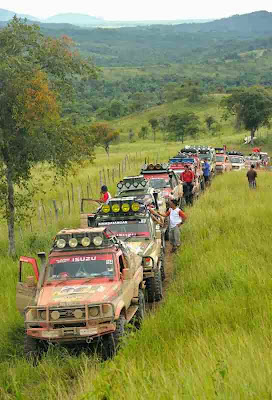
The grassy, rolling hills of Kota Belud.
Recently, the club was reorganised and upgraded to the Sabah Four Wheel Drive Association, which then set the ambitious goal of making the 22nd edition, the Borneo Safari 2012 “”Xtreme Kinabalu”, the biggest and best ever. From the numbers alone over 500 participants in some 200 vehicles over 1,000km in eight days and seven nights they succeeded.
Of course, it was clear that such big numbers could also cause problems with traffic jams in the jungle. With all vehicles going through the same route, simple arithmetic would show that a simple obstacle that takes each vehicle two minutes to clear would take the whole convoy over 400 minutes or six and a half hours to get through! This fear would be realised.

From strangers to brothers
But the true measure of the latest Safari's success lies not in they statistics, they are reflected in the never-ending stories told and retold by those hardy souls who survived this marathon test of Man and Machine.
They are reflected in the bonds of friendship forged on those challenging jungle trails, where strangers from Brunei and Sarawak and Indonesian came together with the other foreigners and the local Sabahans and crossed the finish line as brothers (and a few sisters).
For the non-Sabahan contingent, the adventures began considerably earlier and further away, with the Indonesian “Everything Four Wheel Drive” team led by Susanto “Santo” Harimuljo beginning their epic journey from Jakarta nearly two weeks before the flag-off date of October 29. The first leg of their journey entailed putting their three vehicles a ferry ride to Pontianak, followed by an arduous drive over 400km of rough Kalimantan “roads” to Sarawak's capital Kuching, then on to Bintulu with a brief halt in Miri, then Brunei, through to Limbang, back into Brunei, over into Lawas (still in Sarawak) before finally crossing into Sabah. All this, which would be quite an adventure in itself, is just to get to the start of the Borneo Safari.
Our Indonesian friends upheld the honour of the
Indonesian Offroad Federation in great style.
Along the way, they had to deal with the inevitable vehicle problems caused by gremlins big and small, the unavoidable paperwork and officialdom of multiple border crossings, and the sheer fatigue of motoring long distance over poor roads.
This trial by odometer was shared to some degree by other determined adventurers from Banjamasin in Kalimantan as well as from Kuching and Brunei, who linked up first through modern social networking venues like Facebook and Whatsapp before meeting up along the way and trvelling as an ever-growing convoy, looking forward eagerly to taking on the promised mud and jungles.
The 2012 edition sported a fresh new look, beginning two days before the actual flag-off with an exhibition featuring not just 4X4 paraphernalia but also other outdoor sports and activities such as camping, hiking, all-terrain vehicles (ATVs), mountain bikes, among others.
Sponsors and exhibitors benefitted not only from the publicity and exposure but also enjoyed roaring trade with many of the Safari participants grabbing the opportunity for some last-minute shopping.
Laszlo Gog from Hungary (right) assisting
withe winching needed to get the cars
 through a particularly tough spot.
No matter how long they've had to prepare for this once-a-year event, it seems there are always some items that had been forgotten, or simply some new-fangled gizmo that 4X4 aficionados simply cannot resist, like sleeping bags, camp furniture, apparel, or the latest in GPS (global positioning system) geaar from Garmin.
Isuzu, as the main sponsor of Borneo Safari 2012, showcased three units of their best-selling D-Max double cabins, fully decked out for the event with winches, beefed-up suspension and body armour, as well as the hot-from-the-mould Komodo Extreme tyres from another major sponsor, GT Radial. The Indonesian tyre giant's presence was also boosted by its sponsorship of the three beautifully-prepared cars from Jakarta a Nissan Terrano, a 1970s-vintage Land Cruiser FJ40 and the Toyota Fortuner that would go on to win the coveted Borneo Safari 2012 Car of The Year Award.
Visitors to the Alamesra site, just opposite the popular 1Borneo mega-mall, were not disappointed. They came for acction, and they got plenty as the competitors vying for Safari glory were put through their paces. Continuous rain over the preceding week ensured the special stages (SS) were well and truly soggy and swampy, giving the competing drivers and their vehicles a torrid time while providing the spectators and amateur photographers with plenty of action.
The cool dudes from Team GT Radial, Jakarta.
The competition aspect has always been an important part of the Safari, with each year's winners assured of fame and respect throughout this 4WD-mad state. Glory and prizes aside, victory in the Safari also holds significant commercial value since the workshops and mechanics that helped prepared the winning vehicles can count on a boom in business.
In the early days of the Borneo Safari, the total number of vehicles would be around 30 to 40, with around half of them  competitors. Over the years, the convoy size grew steadily as the event's popularity grew while the number competing for prizes remained about the same, averaging 20 cars or fewer.
Today, the ratio of competitors to “Tag ons”, as the non-competitors and non-officials are called, is almost 1:10.
For anyone with an interest in machines, the Borneo Safari 2012 flag-off day was a feast for senses. Naturally, a parade of over 200 colourful safari-ready 4X4s, all bedecked with sponsorship decals, makes for quite a sight to behold but there was much more, including motorcycles, ATVs, bicycles and even a helicopter from sponsors Sabah Air, who committed a Bell Jetranger to standby for medical and other emergency evacuations should these become necessary during the event and also as an aerial camera platform.
Those familiar with the Sabah 4X4 scene will know that Sabahans don't believe in leaving their beloved vehicles in standard form. If it was good from the dealer's showroom, they have to make it better by modifying, customising, chopping, removing some bits and adding other bits.
What started off as Jimnys from Suzuki are transplanted with turbodiesel engines and axles from Toyota Land Cruiser II's. Hardly any of the boxy Land Rovers in the field were powered by their original engines, and they wear six-studded wheels instead of the trademark five holes. The notable exception was this writer's two-week-old Defender HCPU (high capacity pick-up) driven all the way from Kuching.
The most prominent and clearly dominant vehicles of the Safari have to be the big Ninja, officially the Toyota Land Cruiser 80 Series of 1990s vintage, widely considered the best overlander/off-roader that Toyota ever made. But that has not stopped Sabahan fans from modifying them to be even better, with the most noticeable upgrade being the huge tyres.
Once off the sealed roads and onto the rough stuff, the Sabahans showed they also have their own driving style that differs somewhat from the rest of the world.
Forget about finesse, they have only one solution for all problems and challenges - MORE POWER! As a result, and contrary to popular myth, a lot of parts get broken on the trail, from steering components to gearboxes, driveshafts and other assorted bits, and even a whole engine that blew up.
But what would be a major show-stopper elsewhere serves only to highlight yet another of Sabah's unique 4X4 culture. Help is just a phone call away, and there seemed to be no shortage of obliging parts dealers who would happily deliver an axle or a gearbox and, yes, even a complete engine, to wherever it is needed. And there always seemed to be someone on hand, or several, willing and able to help carry out the repairs and get everyone rolling again in next to no time.
How does one change an entire in the jungle, you wonder? It starts with a friendly supplier delivering a replacement to the spot where you are stranded. A convenient tree serves as the frame for the hoist, with a winch providing the lifting power. The rest is like in your neighhbourhood workshop, but the work is probably completed faster.
The persistent rain that had threatened to turn the entire 2012 Safari into one long slog stopped suddenly on flag-off day and stayed away right until the last day. As a result, everyone enjoyed the fine weather which gave the photographers magnificent sunsets and spectacular shots of Mount Kinabalu. The cooperative weather went so far as to keep away the clouds that normally veil the mountain throughout most of the day.
The route, which was essentially a clockwise loop around the mountain, yielded great views every day when the convoy was not pushing through dense forests.
The absence of rain did not mean the track was easy, though. There were enough muddy bogs, slippery climbs and rocky trails to satisfy the most ardent four-wheeler, to such an extent that most sighed with relief at the end of each tough sector.
Of course, the appetite for adrenalin never really went away for long, so the next obstacle was most eagerly anticipated.
In several stages, winches were absolutely necessary. In fact, the strain was high enough that several vehicles ended up with their winches damaged or destroyed, or suffered catastrophic failure of cables and recovery gear, such as an 'S' hook that was pulled almost straight. Fortunately, no one was seriously hurt in any of these incidents although there were enough minor cuts and bruises to keep the medics busy.

Snakessss
Just for added tension, news filtered through the convoy on Day 5 that someone had been bitten by a snake. Details were sketchy but the expedition medic  was sent to the head of the convoy to assist. Later it turned out that the victims was a local villager, whom the doctor gave first aid to before calling for an ambulance from Ranau to send him to the hospital.
Then, while waiting for the convoy to resume rolling, particpants resting by the roadside spotted a snake in the drain. It was dead and posed no threat. The next day, while slowly negotiating a swampy tract, and awaiting recovery of an overturned vehicle, another snake was observed crawling from beneath a Land Rover into the long grass. The news went out over the radio, and everyone quickly climbed back into their cars and slammed the car doors shut. So, yessssss, we had excitement.
On most days, the majority of vehicles arrived at the designated camp sites in good time, giving the occupants sufficient time to get a good night's rest before the next day's challenges.
The 2012 Safari organisers, especially the recce and scout teams, did a brilliant job in finding great campsites that were spacious enough to accommodate everyone, with plenty of room to spare, and usually with fantastic views as a bonus.
The rolling hills of Kota Belud's aptly named Camp Paradise, which normally serves as the Malaysian military's training grounds for conventional warfare, proved to be a favourite campground. On Day 5, the barren, windblown landscape of the disused Mamut copper mine, over 1,500 metres up in the highlands near Ranau, provided a chilly (10 degrees Celsius at night) alternative to more familiar tropical camping experiences.
After an all-night driving marathon ...
Rest is never totally assured, though. On Day 4, delays during the day resulted in many vehicles having to push on late into the night, tackling a hard-core trail until about 4am, when stuck vehicles blocking the track forced exhausted participants to snatch a couple of hours sleep. Some slept in their cars while others just collapsed into any flat ground beside their vehicles. Then, up at 6am and the slog continued. Through many varieties of mud, through dust and rocks, through mist and fog, the drive continued.
At the end of eight days and seven nights, damaged vehicles had bbeen patched up and washed, and every one arrived safely back at KK's posh Sutera Harbour for a grand dinner, and the presentation of the various awards up for grabs.
Not all walked away with an award but everyone certainly went home with enough memories and bragging rights to last until Borneo Safari 2013.

More photos ...

They don't have a Borneo Safari Jungle Couple Award, or else Dave and Philippa Morris from Australia, via Brunei, would be outright crowd favourites. 


Broken suspension? No problem, line up a couple of batteries and weld away.


Modding for the Safari

So, after reading and hearing all these tales of adventure, you want to bring your four-wheel-drive vehicle into the Borneo Safari next year? Good for you!
The standard 4X4 that you can buy from a number of showrooms these days is a good starting point. This may sound silly but it needs to be said - make sure your vehicle is really a 4X4. The first '4' says it has four wheels, and the second '4' tells you power is transmitted to four wheels. So, you have 4X4s, and 4X2s which have power for only two of their four wheels. And the army has 8X8, 6X6, 6X4, etc. 
Please, please do not call a two-wheel-drive pick-up a "2X4" because you'll be talking about a piece of wood or timber.
And this point (about having a real 4X4) needs to be stressed because there has been at least one Malysian fishing enthusiast who bought a Toyota because all his friends told him the Hilux was the best off-road vehicle around since all the timber workers swear by them. Since he lives in Kuala Lumpur, he had to have an automatic transmission. And, at that time, the Hilux (the SR Turbo version) was available in auto, but only with two-wheel-drive. So, this angling fan went off into the jungle and promptly got stuck at the first patch of mud. And he wondered why.
So, are you sure you have a 4X4? Okay then, read on.
(In the case of the Lone Ranger's Borneo Safari adventures, it was a deliberate effort to find out if the standard T6 Ranger is tough enough to survive the ordeal, and the conclusion is that it is indeed. That does not mean it was easy, or that it cannot be modified to be more capable in the rough stuff. It's no reflection on the engineers' capabilities, it's just that no manufacturer today makes civilian vehicles that are intended to do stuff like they have to do on a Borneo Safari.)
In preparing a (real) 4X4 vehicle for a hard-core event like the Borneo Safari, the main goal is superior ground clearance. That's the strategy. Stuff like approach angle, departure angle and ramp breakover, these are all part of ground clearance.
The tactic to achieve the strategy is tyres. Big tyres. The bigger, the better. And aggressive treads, of course. Many of the mods that you hear people talk about - body lift, suspension lift, etc - are a means to an end, and that end is to enable the car to wear bigger tyres.
The logic is simple. If you have a very tall vehicle with lots of air under the body, it will be less likely to get stuck when deep ruts are encountered, compared to a car with less clearance. 
The vertically-challenged car will likely end up stranded on the high centre of the trail, with all four wheels flailing futilely in the ruts, like a beached turtle.
Even in a situation when all four tyres have insufficient traction to propel the car forward and every car has to rely on the winch to make progress, the taller car will have an easier time because there will be less resistance from the body dragging in the mud.
It's not simply a matter of putting down your money and buying the biggest rubber from the shop because these giant tyres will not be able to fit on a standard car without hitting part of the bodywork or suspension or steering or chassis, or all of the above.
Most medium to large 4X4s that are sold new today, like the ubiquitous double-cab pick-ups and their derivatives like the Fortuner and Pajero Sport, are delivered with stock tyres of about 31" diameter or smaller. 
For decent off-road performance these days, you'd need at least 33", and for the Borneo Safari, preferably 35 inches as a minimum. 
It's a bit like an arms race. If everyone used standard 31" tyres, everyone would be in the same boat, or ruts.
But when one guy uses 35", he will end up creating ruts that are simply too deep for a 33" to navigate. And then some other smart guy will use 36", which give him an edge over all the 35" and 33" cars, until more people show up with the latest 37" rubbers. And then there are the 40"s!
So, aside from a fat wallet (these large Extreme tyres run upward of RM1,000 a piece nowadays), you'd need to create sufficient space within the wheel well.
A Ford Ranger with standard suspension and
 33" tyres is dwarfed by a Toyota  Land Cruiser
 with monster 40" Maxxis Trepador rubbers.
The simplest mod would be a body lift, which entails unbolting the body from the frame, sticking in blocks made of some synthetic plastic like nylon or teflon, and refitting the body about three or four inches higher that it was when it left the factory. It should be noticed that getting a body lift without fitting bigger tyres will yield very little benefit since the axles and differential housings (hence, the car's lowest points) will still be at exactly the same level as before the lift. 
It sounds simple but there are many details to get right, such as relocating the radiator, intercooler and related connecting hoses, brake and fuel hoses, steering and gearbox and transfer linkages, etc. In addition to relocation, some of these components may need to be replaced altogether with longer versions. Done right, a body lift can be an effective way to get bigger tyres on but it can also become a nightmare if not done properly.
Then, there is the suspension left. Longer coil spring, leaf springs and shackles or torsion bars, and matching shock absorbers are needed to put more space between the axles and the car's body. 
There are so many aftermarket options on offer that it is a matter of how much money you have to spend. Reputable brands to check out include Old Man Emu, Tough Dog, King Springs, and more recent players like Ironman, Pedders, etc. 
But do bear in mind that there are also issues that can crop up with too extreme a lift. Things like wheel caster angle and drive shaft angles for cars with independent front suspension (IFS) need to be taken into account if problems are to be averted. 
For example, an extreme lift on an IFS car, coupled with large tyres and a heavy-footed driver is a pretty sure recipe for a broken drive shaft when the muck starts flying. 
It helps to join an online forum or multiple forums that are dedicated to thevehicle you own so that you can learn from others about issues that may be specific to your car.
After the big tyres go on, the next consideration is whether they touch the bodywork when steering to either left or right. If they do (and there's a high chance of it happening if the tyres are a lot wider than standard), then a new set of wheels with more negative offset are in order, followed by a set of aftermarket fender flares to cover the protruding tyres. 
If the credit card is still willing and able, then add a winch, a solid front bumper to mount it on, some heavy duty side steps to protect the side of the car and help you get in and out, plus a heavy duty rear bumper with towing capability, and you're almost ready. There's still the snorkel to aid water wading, and budget permitting, a set of differential lockers to maximise traction.
With the car nearly done, you'd still need an assortment of recovery gear such towing and snatch straps, shackles, S-hook, snatch block, shovels and hoes (cangkul). And don't forget the director's chair. 


Borneo Safari 2013


The ideal place to start my story is a 4X4 adventure in the northern part of Borneo, in what is today the Malaysian state of Sabah, formerly a protectorate of the British empire and, before that, claimed by various parties including the sultanates of Brunei, Sulu (itself now part of the Philippines). (Future posts will cover various of four-wheeling, tales from past trips elsewhere in Borneo, including Sarawak and Kalimantan, as well as Peninsular Malaysia, Thailand, Cambodia and the Sahara desert.)
Sabah is a dream destination for four-wheel-drive enthusiasts from all over the world. First-time visitors will be taken aback by the sheer number of serious-looking 4X4s on the streets and in the parking lots the moment they step out of the Kota Kinabalu International Airport.
Back in 1988, a bunch of 4WD enthusiasts got together to form the Kinabalu Four Wheel Drive Club (KFWDC) to organise events that would enable like-minded spirits to enjoy using their tough, go-anywhere cars in the manner they were designed to be used, and visit places that most other people simply cannot get to without great difficulty.
That led to the Borneo Safari, which quickly grew in popularity over the years, with regular participation from Japan, Australia, Brunei, Sarawak and, of course, plenty of local Sabahans.
For more on the history of Borneo Safari, click here.
Most people who have been on one of these expeditions have come back with tales of adventure, of struggling with the jungle and mud, of the incessant winching, and the rain and the leeches. And raved also about the spectacular scenery, and the extraordinary warmth of the locals, and the camaraderie they enjoyed in overcoming the trials and challenges together with new-found friends.
Some 200 heavily modified 4X4s had entered the grueling expedition the previous year, and a record tally of 255 cars had signed up for the 23rd edition this year.
While there is a competition portion that has always been a backbone of the event, the greatest growth in popularity has been with the Tag-On group, most of whom just look forward to sharing several days of hardcore 4X4 experience with like-minded fellows.
The 2013 edition, with the theme of "Xtreme Trus Madi", would take the participants to the pictureque river valley of Kiulu, about 40km from Kota Kinabalu, through the highlands of Kundasang, and then to the foothills of Trus Madi, Malaysia's second highest mountain.

When one of the scouts who had reconnoitered the route remarked that the hardcore sector of about 20km would be a "10 out of 10" for toughness, there was some scepticism among the old-timers.
The doubts evaporated when reports filtered through the radio that the cars in front were already struggling, even as the sky was still blue and bright. If the past few days' weather was anything to go by, heavy rain could be expected in the afternoon.
With the lead cars making little progress, those at the rear had plenty of time to cook lunch or got out the playing cards to open up impromptu casinos while waiting for their turn.
CURIOUS SPECTATOR ... A leech is excited by the
 prospect of  so many meals on wheels passing by. 
By late afternoon, the dark grey clouds made good on their threat and the torrential downpour made the already difficult going even more treacherous. Pulling winch cables and tow ropes in the rain and mud kept everyone busy until the light began to fade, and it was time to make camp.
The cars in the lead group had probably travelled about 10km after a whole day while those behind had made even less progress.
Camp would have to be wherever the cars stopped, with some of the more fortunate drivers finding at least a little flat, open ground. Then, the leeches started to appear.

With a simple, hastily prepared dinner out of the way, it was time to socialise with fellow travellers, at least, those who still had the energy to remain awake. This downtime at night, with rain falling on the tarpaulin shelters, is one of the most enjoyable parts of the Borneo Safari, where firm bonds of friendship are forged.

Beers are shared, tall tales are swapped, and the conversation drifts from 4X4 vehicles and modifications, to accounts of other adventures and past offroad trips. At some point, the snoring begins and the conversation gradually peters out.
The second day on the hardcore trail would be more of the same, with steep descents into streams followed by heavy duty winching up the other side, with snatch blocks and doubled lines being the norm rather than the exception.
Vehicles in the rear half of the convoy had to cope with the deep ruts and mud churned into the consistency of thick, gooey porridge, thanks to the hundred and more other vehicles that had already passed through.
Every conceivable challenge of off-roading was thrown at the convoy, from tyre punctures to broken driveshafts and other mechanical failures, to overheating engines and winches. If a piece of equipment was not up to scratch, it broke.
Whatever techniques or tips and tricks that one might have heard of around a campfire or read about on the Internet, they became practical lessons on this hardcore stage of Borneo Safari 2013.
Jone Ville Tinun and his Range Volvo ...
The one that they'll be talking about for a long time to come is the steep descent - more than 60 degrees from vertical - down which each car had to be lowered slowly and carefully by a winch attached to the car behind. The last car in each group would have to lower itself down, either with a rear-mounted winch or by going down backwards.
The challenge did not end with getting to the bottom safely, though. There was a large log to climb over and a right-angle turn into a stream, which ended with a tight U-turn up another steep slope!
Even the veterans of many hardcore events had to admit that this was a new experience, a scary one but guaranteed to generate many tall tales that will be the envy of 4X4 enthusiasts who missed out.
And then there was the deep gully at which the sweeper teams had to station three vehicles, all with engine-powered PTO (power take off) winches to help pull the cars through. Even with each winch line doubed up using snatch blocks, it was a titanic struggle to drag some of the heavier cars through.
This was also the obstacle that inflicted the most mechanical damage, with drive shafts snapping, and even the supposedly indestructible PTOs suffering damage.
Relief would be the only word to describe how everyone felt upon emerging from the trail, which entailed three days and two nights of hard struggling to complete. The reward was a huge sense of accomplishment and a long-overdue bath in the crystal-clear and teeth-chattering cold mountain stream.
After regrouping in the central town of Keningau for some much-needed rest and also repairs for many vehicles, the action moved into the foothills of Gunung Trus Madi.
Upon arriving back in Kota Kinabalu for the closing dinner and formalities, the success of Borneo Safari 2013 could be gauged from the scattered conversations among friends old and new - plans for Borneo Safari 2014 are already being made!

More photos on Facebook

More more

More more more