Showing posts with label adventure. Show all posts

Saturday, 25 July 2015

One Life. Live It. (The Camel & I)

Yours truly, circa May 1993, somewhere near Tenom, Sabah.
I was a part of something big a long time ago, something that has had a deep influence on me ever since. It has been nearly a quarter century since I got up close and personal with the ultimate 4X4 adventure, the Camel Trophy, and it is still a part of me. In my own mind at least.
No, I was not fortunate to have been one of the participants vying for the coveted Trophy. After being captivated by the cool and oh-so macho ads for several years, the opportunity to be among those rugged adventurers came along in 1992, when I was about to turn 30.
I was living and working as a journalist in Sabah when it was announced that the beautiful north Borneo state had been chosen to host Camel Trophy the following year, 1993.
What joy, what excitement! I had just completed my first ever major 4X4 expedition, the Borneo Safari, and was already hooked.
But my own life was in a state of flux. An opportunity had come along that I could not pass up, a chance to work with The Star, a major national newspaper that also meant a big step forward in my career from the small regional newspapers that I had been working for (and enjoyed doing so, might I add).
With Team Italia (from left) Giovanni Formica, me, Francesco Rapisarda,
Matteo Ghiazza and a journalist whose name I do not recall.
Not only were the Camel Trophy selection trials set during a period when I was busy with preparations for the big move across the South China Sea, the actual dates coincided with the wedding of my only brother. So, I had to pass on it, and probably miss my best opportunity to be a part of this great adventure.
While still in Sabah, shortly before Christmas, my Sunday morning lie-in was shattered by the telephone. I ignored it, but it would not stop. So, I had to get up and answer it.
“Paul, can you go to Milan?” It must be some kind of bad joke. On a Sunday morning. I had already resigned from my job in Sabah.
But the voice was familiar, the nice PR (public relations) lady from Sabah Tourism Promotion Corporation.
“Can you go to Milan?” she repeated when I mumbled something unintelligible.
“Milan, as in Italy?” I asked. The furthest I had been sent on assignment in the past three years was Semporna (yes, that’s also in Sabah).
“Of course Italy, is there any other? More importantly, do you have a passport?”
Yes, I had a passport, and within 24 hours, after a lot of hurrying to collect air tickets and round up cash, I was on my way to Europe for the very first time.
It was the bad luck of my good friend Freddie Ch’ng who was supposed to go but had his house broken into and his passport stolen a couple of days earlier. Sorry, Freddie, your loss was my gain.
The reason for this surprising turn of events was the Camel Trophy. The Italians had invited the then Sabah Foundation chairman, Tengku Adlin, to go and give a talk in the northern city of Milan about the coming event, in particular about the “Lost World” of the Maliau Basin.
So it was that a son of Borneo landed at Malpensa Airport, dressed in full Camel Adventure apparel while, all around, the local signoras were bundled up in furs and the gents in great coats.
The airport was being renovated so the aero-bridges could not be used. We had to walk across the tarmac to the terminal. I had brought winter gear but it was in the luggage. Not a good start.
After a few more misadventures through inexperience, we finally made it to the Milan office of RJ Reynolds, where their PR Francesco Rapisarda manager showed me what the Camel Trophy had been all about.
Tengku Adlin (2nd right, front row) and the other local officials.
In the event just past, Guyana 1992, the clippings from newspaper coverage alone, excluding other media, was compiled into a book two inches (50mm) thick! That was how wildly popular the Camel Trophy was!
He reeled off more figures - more than a million Germans had applied to take part, along with several hundreds of thousands in each of the other European nations involved, including Italy, the Netherlands, Portugal, Spain, Russia, etc.
We were then introduced to the Italian team of Matteo Ghiazza and Giovanni Formica, who would pilot the Sandglow Discovery through the jungle trails of Sabah in the coming months.
Tengku Adlin gave a passionate speech about the wonders of Sabah that they could look forward to seeing, and we learned that state’s name may not be familiar to the Italians but they all knew the name of Sandakan. Well, Sandokan anyway, close enough. Apparently, it is a place featured in a popular series of stories for children so every Italian grew up dreaming of visiting Sandokan some day.
An icon of Camel Trophy, the pontoon raft in action.
For the fortunate four (two primary participants and two reserves) from each other participating nations, Italy continued to be a part of the story because a week of intensive training was held in the mountainous north of the country. But I was not a part of that and, in fact, thought that was about as close as I would ever get to the iconic event.
I was in Kuala Lumpur when the adventurers and crew flew into Kota Kinabalu.
Then, another unexpected phone call. Would I like to go back to Sabah? To cover the Camel Trophy?
And just like that, I was off on another adventure, this time even greater than Milan.
Leaving familiar KK behind, I could barely believe I was really going to be part of the great adventure as I rode the rickety train from Tanjung Aru to Beaufort where we joined up with the convoy of yellow (okay, technically Sandglow) Land Rovers, also riding on a special train, on our way to Tenom.
It felt like being in an Indiana Jones movie as we enjoyed the scenic views of the Padas Gorge from the flatbed cars and carriages reminiscent of the Wild Wild West while a couple of helicopters swooped up and down the railway, shooting video.
The next few days were spent camping near the river as the participants were put through their paces, competing in various special stages and exhibiting newly-acquired skills in setting up the inflatable pontoon raft that could ferry a heavily laden Discovery across the river.
To say I was happy would have been an understatement. I loved the challenges, the great outdoors, the camaraderie of the multinational participants and crew, as well as the local 4X4 enthusiasts from the Kinabalu Four Wheel Drive Club (KFWDC) who were drafted as officials. Many of them remain my friends to this day.
Riding on the roof of a Discovery as the convoy made its way back to KK for the finale was icing on the cake.
The Americans won the Camel Trophy that year and the popular and ever-cheerful team from the Canary Island were presented with the Team Spirit Award.
The Malaysian team did not do so well, coming 16th out of 16 competing teams. Some things did not go well that are best left unsaid as I prefer to focus on the positives that came out of the event, and these were huge.
I longed to own one of those magnificent Land Rovers but, for many years, it remained a dream that was out of reach.
I settled for buying and wearing the Camel Adventure apparel, boots, watch, and whatever memorabilia I could lay my hands on.
From the first 4WD, a beat-up Isuzu Trooper I acquired in Sabah just before the 1993 event, I went on to buy more 4X4s, and eventually owned only 4X4s and no saloon cars. As part of the job, I had chances to take part in other adventures, including numerous Ford Lanun Darat trips, the Trans Sahara 2004 with the Petronas Adventure Team, the Mercedes-benz Paris-Beijing 2006 and several Ford Adventures in Cambodia.
But, I never forgot the dream and one day in 2008, I managed to buy a used Discovery of my own so that I could build a replica. I called it “Humphrey” because the Discovery has a hump in the roof, and of course, camels, too. And it is ever so English, like Land Rovers.
'Humphrey' on adventure.
I have gone on to more memorable adventures after shipping it and myself back to my home state of Sarawak, to explore the highlands of Long Semadoh and Ba’kelalan, and crossed the border into the Indonesian part of Borneo, retracing parts of the Camel Trophy 1996 route through Kalimantan to Balikpapan, and visiting Banjarmasin, Sampit, Pontianak and other exotic places.
One is never enough, so I went and acquired a 1986 Land Rover 110, and then another, this time a 2012 Defender. Eventually, the newcomers were also repainted in that iconic shade of yellow, Sandglow LRC 361. So yes, you could say I liked the Camel Trophy.
Out of the blue, on the 25th of July, 2015, I received an email from a Mr. Nick Leadbeter, Chairman of the UK-based Camel Trophy Club, inviting me to be an Honorary Life Member. I am honoured, and I accepted.
The adventure continues even if the event itself ended with the old millennium.
So, what is it that made the Camel Trophy so special to me? Yes, it was a marketing exercise, with interested parties trying to get you to buy their stuff. But unlike the millions of other advertising stunts we are bombarded with each day, the event took on a life of its own, one that was larger than real life.
The beautifully shot stills and videos in the ad campaigns sold us on the idea that there was more to life than the daily grind, that there was a big, wide world out there that we could go explore, even in the late 20th century.
The reality was even better. Gather the fittest and brightest young men and women (military folks excepted) from around the world, give them identical vehicles and equipment, and let them loose on the wildest and toughest terrain out there.
While the “Trophy” bit shows it was a competition, and there were indeed competitive stages that pitted one nation against another, what really made the Camel Trophy memorable was the transport stages.
“Transport” may sound humdrum but just getting from Point A to B in the areas that Camel Trophy went to was truly an adventure.
Mud and sand, bogs and dunes, giant trees or not a blade of green at all, the organisers went out of their way, literally, to scout the world’s most inhospitable places. The Amazon, the Congo, Borneo, Patagonia, Siberia, the Maya heartland, all locales whose names alone would excite Indiana Jones as well as wannabes.
And the best, really best part, was the teamwork that got everyone and every car through each seemingly impassable obstacle. Russians working alongside French helping Japanese and Portuguese, all communicating with some English and a shared love of adventure.
When the finale was over and the trophies handed out, what really remained for the participants and fans was not who won or did not win, but the extraordinary experiences they had shared along the way.
Of course, the event was a big boost for Land Rover as well, even if the reality was that Camel Trophy actually began with three Jeeps! Over the years, unforgettable of the various models of Solihull’s finest have been etched permanently in the subconscious - a Landy can go anywhere, if the drivers are up to it. Which is why I ended up with three of them.
One Life. Live It.

Matteo Ghiazza blows his horn.
More vintage photos from Camel Trophy Sabah 1993


Today ... because one is never enough.

More pictures of "Humphrey - The Making Of ..."

An honour, gratefully accepted. Thanks, guys.

Thursday, 12 June 2014

Not quite Borneo Suffering, but still Drama kot


When Sabahans tell you that a 4X4 expedition is "hard core", believe them. When they say the next trip will be super hard core, be afraid. Be very afraid. Especially if they invite you to go along, and you're freshly out of excuses to decline.
For years, I've been hearing about this place called Deramakot. Whenever Sabah Offroad Adventure Association (SOAA) members get together and the chat turns to how tough a just-ended trip had been, it crops up, "have you been to Deramakot?" It means "you don't know what tough is till you've done it."
If you have been, then the recent event is compared to Deramakot. If you have not, you shut up and listen to the veterans' tall tales about winching 30 times to get up one hill. About taking a whole day to cover one leech-infested kilometre, about having to drag along crippled and broken-down vehicles when even the best-equipped, fully functioning Land Cruisers find the going torturously slow.
And the SOAA has a couple of RTM-made videos on YouTube to back up their claims.
Deramakot Forest Reserve comprises 55,139 hectares of mixed dipterocarp forest located some 160km south-east of Kota Kinabalu and 90km south-west of Sandakan.
Within its boundaries, there are several disused logging trails that can be explored with suitably-outfitted 4X4 vehicles, with prior permission from and under close supervision by the Sabah Forestry Department.
Over the years, these trails have provided a suitable challenge for many expeditions big and small, including the annual Borneo Safari organised by the Kinabalu Four Wheel Drive Club (now evolved into the Sabah Four Wheel Association).
In January last year, the SOAA mounted its first expedition to Deramakot, dubbed "Survival Of The Fittest" that apparently lived up to its billing, and then some. They're still talking about it.
Like a good horror movie, the tales are both scary and irresistible at the same time. The hard slog that went on day and night as the rain hammered down incessantly, and the numerous obstacles that broke even the toughest vehicles, should have been enough to deter any sensible person from attempting the trek again but, like a flame draws a moth, the stories only drew even more 4X4 aficionados to Survival Of The Fittest II.
"Our members have been clamouring for a return to Deramakot, especially those who missed out on the first round last year," said SOAA president Hiew Min Kiyun.
When they invited this writer to go along, the reaction was definitely one of mixed feelings. The experience would be welcome, as would the bragging rights as a survivor of Deramakot. But, being more of a leisure, cold beer and camping kind of guy, did I really want to suffer for three days and two nights? Well, the pull was strong, and the push was that I had run out of excuses.
Hopping into the Land Cruiser 80 Series, the legendary "Ninja Turtle" of Expedition Leader Alvin Leong and co-driver Vivian Julip for the 200-plus kilometre drive from KK through Kundasang and Ranau to Telupid, I was treated to more war stories from the previous year's trip.
After turning off onto the unpaved track to the forest reserve, there were hints that this year's event might be less stressful, even if just a little.
The local weather had been dry for some time, and the dusty road had coated the grass and oil palms that lined the70km route with a thick layer of orange-brown dirt. Anyone who has experienced off-road driving would know that the difference between a dry and a wet track can be huge.
But, just after the convoy arrived at Sabah Forestry headquarters and set up camp, the rain began. Game on! Maybe. The shower did not last long.
After dinner, the participants were required to attend a briefing by the forest rangers on the Deramakot Forest Management Unit's reason for being and the many do's and don'ts for all visitors, especially the strict rules on trash - everything brought in, even cigarette butts, must be taken out from the jungle.
The repairs begin ... after less than 1km.
Action began early the next morning when the convoy encountered a deep V-gulley just 800 metres after turning off the road and winching started in earnest and the first leeches showed up.
The first mechanical problems cropped soon after, with a ruptured air intake hose signalling that the vehicles were in for a pounding.
The horror stories of the previous trip had inspired all car owners to check and prepare their vehicles meticulously but Deramakot seemed determined to live up to its reputation, even if the sun was blazing down at that early hour.
This was going to be a contest between Man and machine on one side, and Nature on the other.
The trail had not been traversed by vehicles in over a year, and was thickly overgrown.
And here they come ...
The 4X4s had to force their way through grass and other plants that were as tall as a man, while branches and bamboo reached out from the sides to claw at the passing vehicles.
At times, it sounded like a bunch of unruly children were whacking the cars with sticks while others were scratching blackboards with their fingernails.
From then on, it was hard going but not super hard core. There was no rain. The ruts were deep, the hills steep, but no rain. Progress was slow at an average of about 5km/h, but that's fast compared to a kilometre a day of previous Deramakots. Because there was no rain.
It was still very much a hard core event, with lots of winching and breakdowns but, for the well-prepared cars and participants, not the ultimate hard core event that had been anticipated.
By day's end, the convoy had covered about 12 kilometres of the 20km trail before stopping to set up camp and fend off the few leeches that showed up.
The next day served up some mud pools and fallen trees but everyone made it out in good time and camped in relative comfort at the "White House", a bungalow for the staff of Deramakot.
The third night that had been allocated for the event was spent at Mesilou, about 5,800feet above sea level up in the Kinabalu highlands, where the freezing temperatures were a welcome change from the windless heat and humidity of Deramakot jungle.
While everyone was glad to be out without too much human suffering and damage to vehicles, many participants were left with a feeling of unfinished business.
While it was still a Drama-kot, it was not quite the "Borneo Suffering" we had anticipated. There is a need for a Survival Of The Fittest III, preferably during the wet season. But at least I am now ranked among the Fittest!


Human ballast to prevent a 3-tonne beast toppling into the mud pool.

A cry of "pacat" (leech) is enough to get squeamish types to drop their pants!


About Deramakot Forest Reserve


Map courtesy of Sabah Forestry Department.


There are logging trucks in Deramakot Forest Reserve. Because there are loggers. Yes, they cut down trees. No, it is not a mistake, nor is it a blatant disregard of regulations.
The reserve's raison d'etre, its reason for existence, is to conserve the natural resources, not to preserve. While it may be puzzling to first-time visitors, there is no confusion among those rangers who serve.
Deramakot is billed as a "well-managed forest" to be used and exploited responsibly for the benefit of the state and its people, not a virgin jungle to be preserved.
According to www.deramakot.sabah.gov.my, it was created in 1989 when the Sabah government realised that the state's forests was being depleted, including Deramakot. With help from the German Agency for Technical Cooperation (GTZ), it developed a management system aimed at responsible production of timber for logged-over forests.
The goal is "ecologically and scientifically acceptable forest management ... the intent is to manage the commercial forest reserves in a way that mimics natural processes for production of low volume, high quality, high priced timber products in a sustainable manner.
"Sustainability is defined in terms of balance nutrient cycles, forest structure, biodiversity, forest function and socio-economic needs."
"DFR will be managed under sound forest management practices in accordance with the biological, social and economic principles defined by the International Tropical Timber Organisation (ITTO), Malaysian Criteria and Indicators (MC&I), and in conformity with the existing State forest policies, environmental policies, legislation and regulations."
At the briefing for participants of SOAA's "Survival Of The Fittest II", the senior ranger said that selected trees were harvested by appointed contractors who are paid for their services while the logs are auctioned off to the highest bidders. The proceeds go to the state and are used, among other things, to pay for the upkeep and protection of the forest reserves.
The local communities living nearby are also looked after through a committee called the "Deramakot Social Forestry Committee (DSFC)". Periodic consultations with the local communities are held every 4 months.
There are no communities inside the reserve, but five villages (each comprising 20 - 50 households) located on the southern fringe of Deramakot FR have been identified.
The stated goals are to provide training and developing skills such as producing functional and decorative handicraft to ensure local communities of a livelihood; provide basic amenities such as clean water, school, etc.; and to create jobs, in line with the government policy to eradicate rural poverty.
Wildlife is also protected, with about 75% of mammals in Sabah found in Deramakot, which is a key habitat for five globally threatened large mammals: Orangutan, Pygmy Eephant, Tembadau (Banteng), Proboscis Monkey and Clouded Leopard.
Eco-tourism, defined as "responsible travel to fragile, pristine, and usually protected areas that strive to be low impact and (often) small scale (as an alternative to mass tourism)", is also encouraged.
Its purpose is to educate the traveler, provide funds for ecological conservation, directly benefit the economic development of local communities.
Hence, events like the 4X4 adventure organised by SOAA and earlier Borneo Safaris (by the Kinabalu Four Wheel Drive Club) are welcome, with strict conditions and, of course, payment of fees.
The visitors must be accompanied by forest rangers who ensure that all rules, especially those governing cleanliness and wildlife protection, are complied with at all times.


Tuesday, 14 January 2014

It Was A Dark And Stormy Night

It was a dark and stormy night. (I always wanted to start a story with that!) But it was really a dark night, at least. And it was raining. And there was a little lightning. So, yeah, a dark and stormy night it was on Jan 5, 2014.
My phone rang. I was not expecting any call. It was Alvin. He sells Fords for a living, and drives a Mitsubishi Triton. Why would he call me on this dark ... evening?
I pressed the green phone icon. "Hello?"
Alvin asked where I was and, before I could answer, launched into an excited stream of words that I could barely make out.
"Calm down, Alvin, I'm at home ... Bau, now tell me, slowly, what's going on."
The short version, he was also in Bau, at his wife's kampung, about 35 kilometres from my home. He had driven into a rubber estate to explore around 4pm, then decided to turn around when it started raining.
The track had become slippery very quickly, his Triton slipped off the track on its left side, coming to rest against a rubber tree. That tree propped up the truck and probably saved it from tumbling down the slope.
He needed rescuing. I was the nearest person he could contact who had a mission-ready 4X4, my trusty Borneo Safari veteran Land Rover Defender 110 HCPU (Hi-Capacity Pick-Up).

Not the best photo ever, but I was on a rescue mission, not a photo safari.


The game was afoot. Grabbed appropriate shoes, raincoat, hat (I did say it was a stormy night, didn't I) torch, straps, shackles, checked that remote control for the Warn 8274 was in the car, all good to go.
With the benefit of hindsight, should have also grabbed the handy VHF radio to go with the car-mounted mobile set, and extra torches. But I didn't. Managed without but would have been easier with.
Also, made a phone call to another buddy, Chai Yew Foo, to let him know what was happening. This was Plan B, always good to have back-up. He "rogered" and said he and his Landy Double Cab (DCPU) would be on standby. A quick post on Facebook mobile would also alert the local 4X4 community in case more help was needed later.
Road being wet and everything being dark, I drove cautiously and got to the Kg Stass junction about 45 minutes later, met up with Alvin and went to see about rescuing his stricken truck.
It was not that far from the main road, less than a kilometre.
After descending a mild slope to get to the site where the Triton was leaning against a tree, I hooked up the winch to his front recovery point and began reeling the plasma rope in.
No good, it only pulled my Defender down towards his truck.
Unhooked rope, drove in a little further and managed a tricky three-point turn and then tried to climb back up the slope.
The rain had turned the surface of the clay trail into a slick grease-like layer. There was no traction to be had, even on GT Radial Komodo MTs, which had proven quite competent in most other conditions.
A ditch running diagonally across the track ruled out a run-up to build up momentum for a charge up.
So, the plan evolved into a winch-up for the Defender, using a longer (8-metre) strap to tie the Triton to the Landy's rear bumper.
After three cycles of winching and relocating anchor point, I was sure that Alvin would be able to drive up on his own since the Defender no longer needed winching, it could climb under its own power.
But, no joy, his tyres just spun uselessly while the Triton swayed side to side. It was really slippery, and footing was treacherous for humans as well.
Only then did it occur to me to ask Alvin; "What tyres are you using?"
ATs, came the reply from the darkness. Ahhhhhh so. All Terrain tyres, a highly optimistic name.
Around this point, I really rued forgetting to bring the extra radio. It would have made communication between Alvin and me a whole lot easier.
So, the winching continued until the two-car train reached level ground.
Tired, thirsty, wet and very muddy, we had made it. The phone rang again, and it was Foo and another buddy, Keith, asking where we were and how things were going. They were on their way to our location, about five minutes away.
We waved off the cavalry, all was well and made arrangements to meet up for celebratory drinks at Bau town, about 20km away, after a quick clean-up at the Petronas station nearby.
And so, all was well that ended well. Alvin is looking for better mud tyres.
Now, if you'll excuse me, my phone is ringing ...


Sunday, 15 December 2013

Playing Dirty, Staying Clean

There's ordinary dirty, and there's Ba'kelalan dirty.
Does your car wash kit include a spade? Ah Ngiu's does.
This is a black truck. Pic courtesy of Vance Lee.


When you take a 4X4 out to play in the mud, it's going to get muddy. That's kind of obvious, don't you think? So, we've established that 4X4 people don't mind getting their cars dirty.
But there's dirty, and there's really dirty, really very dirty and then there's outright filthy. Ordinary dirty is fine, that's no worse than driving on any city road in Malaysia after it rains, and especially just after you've washed your beloved ride.
But out on the trail, things get really messy. There are many kinds of mud, of varying viscosity and consistency and colour. Some will stick to your door handles, and windscreen, and side windows, and side mirrors, and cling o your shoes when you step out. All this is OK, all part and parcel of offroading.
Then there's the mud that gets shoved into every nook and crevice underneath the car, coating the suspension, steering, propshafts, gearbox ... in short, everything. And there's mud that clogs up the wheels (or rims, if you prefer) which is great for taking photos of that tell your friends how tough the trip was and, by extension, how tough you are. They are also okay, until you get back on the tarmac and begin to drive at normal road speeds, at which point they may cause enough imbalance in your front wheels to cause varying degrees of vibration.
One of the most important factors that determine how well your4X4 vehicle progresses in rough terrain is the tyres. Generally speaking, the bigger the tyres, and the more aggressive the treads, the better your progress will be.
To fit bigger-than-standard tyres, you'd probably need a new set of wheels that have a more negative offset than standard, i.e., they place the tyres further from the car's body. Without this extra offset, chances are high that the front tyres will foul parts of the wheel arch or suspension components or other parts of the body work.
But the negative offset (relative to standard wheels) will likely push the outer edge of the tyres beyond the car's fenders or mudguards. If aftermarket fenders are not added to ensure the tyres are shielded, then they will throw up mud with every turn, and this mud will end up all over the sides of the car. If the tyres protrude enough, it does not take much dirty driving to have the entire sides, including the windows, completely caked with mud.
The problem then is you won't be able to see. The front windscreen will also get dirt but at least the wipers and washer jets can help keep it clean enough that there is visibility directly to the front but you may have zero visibility to either side. It's safe to say that this is not a safe situation to be in when negotiating difficult terrain.
Furthermore, it is also illegal to have tyres protrude beyond the car's bodywork so, while it may make your truck look mucho macho, it will also attract the unwelcome attention of the JPJ and possibly the police.
To avoid all these problems, the solution is to add wider fenders that sufficiently cover the tyres.
There are two main types available - the rigid or semi-rigid types that are specifically made for a particular vehicle. For example, a Land Cruiser owner will have to find the specific model of fender made for his particular model car, and it will be different from those for Ford Rangers, which are different from the type for Mitsubishi Tritons, and so on. These would usually be the best option if looks are important but they tend to be fairly expensive. Try checking the various accessory reatilers on the web to find out just how much.
A cheaper solution is generic flexible flares that are one type, suits all makes. I came across a Facebook post by Billy Chan advertising this type for sale, and followed up with the advertiser, Ambassador Industrial (M) Sdn Bhd, a Malaysian subsidiary of an Australian company. For further information on the product, shipping and pricing call Billy on 0193250187 or message him through Facebook.
Now, let's get technical. Their product is flexible fenders extensions made from EPDM rubber (ethylene propylene diene monomer). I have forgotten most of my high school chemistry so this is what wikipedia has to say about EPDM: a type of synthetic rubber, is an elastomer which is characterized by a wide range of applications.
The E refers to ethylene, P to propylene, D to diene and M refers to its classification in ASTM standard D-1418. The M class includes rubbers having a saturated chain of the polymethylene type. Dienes currently used in the manufacture of EPDM rubbers are dicyclopentadiene (DCPD), ethylidene norbornene (ENB), and vinyl norbornene (VNB).
The main advantage is that it is cheap and cheerful. An average 4X4 needs 6 metres of the material, and this costs less than RM200, inclusive of courier delivery (to Kuching, in my case). This sum is to cover all four corners.
Moving along, I placed an order and within a couple of days, had the product in my hands. They had several profiles available and I asked for two types because of my peculiar needs.
My Land Rover 110 Defender High Capacity Pick-up (HCPU) is different from most other vehicles in the fender department because it has cargo tub that's wider than the cabin, so it comes from the factory with front fender flares as standard, but none for the rear. If it had been left well alone to run on standard tyres and wheels, this arrangement would have been fine because the every part of all four tyres would be completely covered. But, as mentioned above ...
Pneumatic riveter, broad head rivets ...
Fitting was relatively straightforward, requiring basic DIY skills, a power drill and a riveter with some 35 to 36 rivets. I chose to get professional help because there's this friend who has all kinds of nifty tools, like a pneumatic (compressed air-powered) rivet gun which makes everything so much more effortless, and also a supply of special rivets with extra wide heads that mean washers are not needed.
Only when we had gone more than half way through did we realise something was not quite right, and the flares looked wrinkly. So, we got a couple of strips of 1.3mm aluminium plate and riveted them as support, and it worked a treat.
A bit crooked ... but sorted eventually.
Later, I found out from Ambassador that the fender flare type I was using, WF 100, had a small hole running along the outer edge that I was supposed to thread a steel wire through to stiffen it. Ah so. But it was already installed and shoving a wire through is definitely easier done before the rubber is bent to fit the flare. So if you are inspired by this post to try the flares, take note.
The finished fenders look good, and the last couple of rainy days have confirmed that they work well in their intended roles.
That is, they will stop your car getting dirty from mud and other gunk thrown up by your own tyres. They are not guaranteed to keep your car shiny clean because there are so many other sources and causes out there that can dirty your pride and joy.
How well they hold up to abuse in the rough stuff, we will know only by putting it to more tests, including the tests of time. Stay tuned for updates.

Photos here

Before ... wheel sticks out.


After ... all covered up.


There are several profiles and widths available, to suit various needs.

Wednesday, 11 December 2013

This IS Africa!

I didn't just do 4X4s, Lamborghinis and jetplanes, I did two-wheelers, too. Especially when it's in some exotic location like South Africa, and at the invitation and expense of some well-heeled party like BMW.


IT’S Africa. This succinct phrase seems to be explanation enough whenever a wide-eyed visitor to the continent expresses awe, amazement or wonder.
A hole in the ground, about three inches (70cm) across, one of many that dotted the wide expanse of grassland, had prompted a question.
“It’s a mouse hole,” the tour guide explains with a knowing grin, obviously anticipating the next query.
It comes. “That’s huge … you must have very big mice here!”
“It’s Africa,” he replies, and that says it all.
Africa is home to the planet’s most fascinating creatures – the biggest, tallest and swiftest. A huge land of dazzling contrasts and breathtaking beauty.
It is also the ideal place for BMW to show off the R 1200 GS enduro tourer, the latest creation from its motorcycle division, BMW Motorrad.
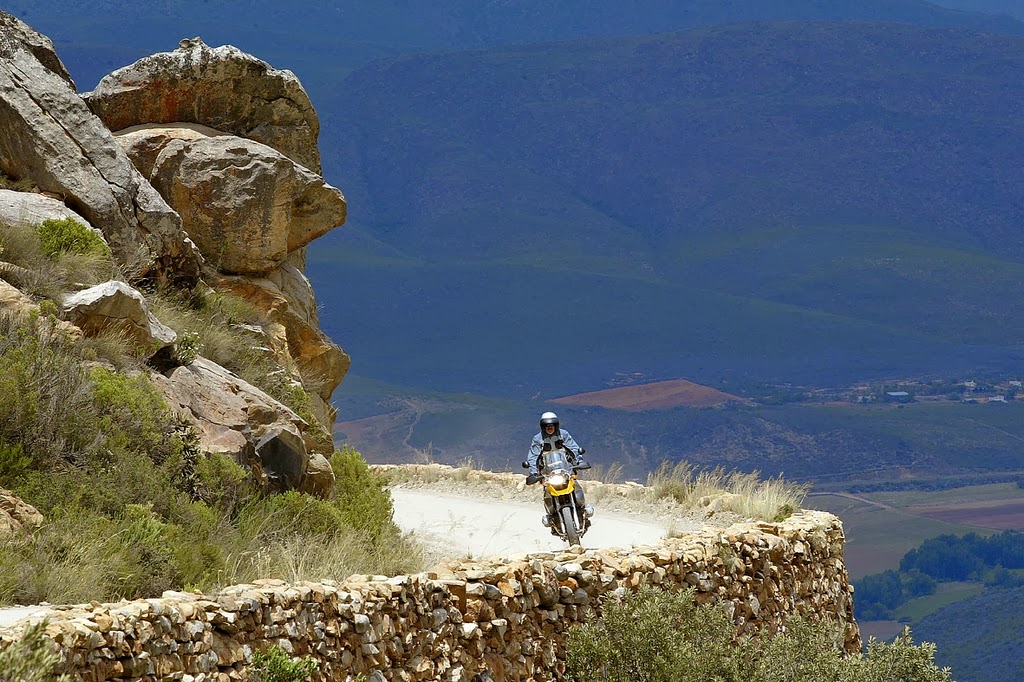
Apart from grassy fields with giant holes and fantastic wildlife, South Africa offers a kind and temperate climate, well-designed roads with cambers and curves (that make for motorcycling heaven), which pass through some of the most spectacular landscapes money can’t buy.

Top Gear Malaysia editor Hezeri Samsuri.
And so it came to pass that I recently found myself in a town called George, about 400km east of Cape Town. It is a small settlement, the sixth oldest in South Africa, and famous for being the starting point of the Garden Route. As the name suggests, motorists are in for a visual treat.
The roads take you past lush plains painted in various shades of green, with a dash of brown for contrast, and a range of rugged mountains which form an imposing backdrop.
Take a right turn somewhere and you head for the mountains, which loom larger as the macadam snakes its way upward. It makes for a great drive in a nice sports car; still, it is nothing short of awesome on a powerful and well-behaved motorcycle.
BMW’s R 1200 GS qualifies as a powerful and well-behaved motorcycle, but it is also much more than that. It represents the sum total of lessons from over 80 years of history, of concepts laid down early in the 20th Century, and of technology that is so cutting edge that it continues to evolve every day. It is the mechanical embodiment of the philosophy that true principles and values need never change, and improvements should never cease.
The bike is virtually all new, sharing little with its immediate predecessor, the R 1150 GS, except a lineage that goes back to the world’s first super enduro – the 800cc R 80 GS that was shown to an unsuspecting world in 1980.
In those days, there were small and light dirt bikes with single-cylinder engines of up to 500cc, at the most. Big multi-cylinder engines were found only on big, heavy road bikes. GS, which stands for Gelande Strasse (German for “off-road” and “road”), changed all that.
Initially, sceptics thought the Bavarians had gone mad. As a university student then with a youthful passion for powerful motorcycles, I also thought it would never work because no one would want a scrambler so huge that you could not possibly do motocross with it, and a road bike that could not possibly keep up with the others because it looked so tall, bulky and ungainly.
The Paris-Dakar rally, which started around then, proved the critics wrong. Today, the GS family are the best-sellers in BMW Motorrad’s line-up, and every other motorcycle maker has big dual-purpose machines in the catalogue.


If you want to see the world from a motorcycle saddle, a bike like the GS is ideal. It’s built tough to take the pounding, and has a big low-revving engine designed to lug plenty of luggage without complaint, kilometre after kilometre. Since most customers don’t actually ride around the globe, there must be something appealing about owning a machine that can do it. It helps you look like you could – should you ever feel inclined to.
With the big GS Boxers (so named because the engine pistons’ back-and-forth motion resembles the punching fists of a boxer) accounting for 15% of all BMW motorcycle sales, no effort was spared to ensure the new model would be significantly better than its predecessor.

The single biggest advance the BMW engineers have achieved in crafting the R 1200 GS is represented by a plastic drum (in BMW blue, of course) which holds 30 litres of water. On it is painted a white circle and cross hair, representing the target – lose 30kg. It was a reminder for the engineers who turned up for work each day that weight was the enemy.
That would be a significant achievement these days for a compact car, and really quite incredible for a motorcycle of this size, which typically weighs about 250-260kg.
The strict diet of precise calculations, new construction techniques and high-strength lightweight materials worked, and the big machine weighs in at a trim 225kg, ready to hit the road with oil, fluids and a full tank of fuel. On top of that, they pushed power and torque up by about 18% and fuel consumption down by 8%!
The horizontally-opposed twin engine, a BMW trademark since the 1920s, retains the traditional look but has been totally revised inside and out. A balance shaft was added (for the first time in a Boxer) to achieve smoothness at high speeds, plus loads of new electronics. Light materials, such as magnesium, and the most advanced calculation and simulation methods have been used extensively to keep the weight down. All these trimmed off 3kg, despite a 40cc increase in displacement over the old engine of the R 1150 GS.
The unique Paralever rear suspension and the Telelever front, and every other structural part of the machine were also subjected to the same ruthless weight loss regime by the fanatical slave drivers in Munich, who trimmed a kilo here and a few hundred grams there, while increasing strength and stiffness.
The result is a wonderful ride, although getting on the machine is a tall order for the vertically-challenged, which would be anyone under 170cm. The seat height is 840mm; you can swallow your pride and ask for a lower seat (with thinner padding).
Styling has also been improved, although this is a subjective area. The 1150’s beak-like over-fender looks like it has been tacked on to the bulbous tank; the new design sports lines flow more smoothly, and the Telelever’s “chicken wishbone” does not look so prominent.
A stab of the starter button produces a throaty, yet muted, growl from the exhaust. It sounds great but a check on the source of the sound reveals that even BMW has not been able to overcome the bane of chromed pipes, which turn blue, with a hint of gold, when subjected to heat.
Blipping the throttle at standstill without having any gear engaged causes the bike to lean to the right. Yes, this is a true BMW, and that tilt is an unmistakable by-product of the rotating crankshaft’s torque. Once on the move, though, the torque is cancelled out by the driveshaft.
The 20l fuel tank forms a big hump in front of the rider, and the typically-built Asian will probably find balancing the machine quite a handful, especially when it is difficult to get both feet planted firmly on either side.
Once in motion, though, all these niggling concerns vanish and the rider becomes one with the machine. That may sound clichéd but it is so true.
A hundred horses pulling an all-up weight of 225kg bike plus 80kg rider wearing 10kg of helmet, boots and protective clothing translates to a power-to-weight ratio about five times higher than your average family car with just the driver on board.
Unlike motorcycle engines of yore, modern bikes like the R 1200 GS have plenty of torque on tap throughout a wide range of revolutions – over 100Nm from 3,500rpm to 7,200rpm – so gearshifting is pretty much optional when cruising.
At the South African speed limit of 120km/h, you can stay in 4th, 5th or 6th. If the need to overtake arises, 4th will do, as will 5th or 6th. The engine is not loud enough to overpower wind noise at those speeds and the only way to find out which gear is engaged is to look at the indicator on the instruments. I found myself doing that a lot.


The light weight relative to its size means the R 1200 GS is susceptible to crosswinds. My machine and I were pushed about several times when hit by strong winds blowing across the vast plains, and also in the mountains, where valleys can funnel air currents into gusts.
The modest windshield does an excellent job of protecting the rider, but only against the wind generated by forward motion. Crosswinds result in severe and tiresome buffeting, and comfort is to be found only in riding a bit slower. Of course, ‘‘slow’’ is relative on a machine like this.
BMW picked a great place to showcase the R 1200 GS’ talents, with the winding roads drawing out an outstanding agility that leaves the rider begging for more.
The protruding cylinder heads typical of the Boxer always look like they’re in danger of scrapping the tar when you lean the machine over, but they never do. Lean left, right, left, right, left again, and some more as the corner tightens, and the bike just responds as if it were an extension of the rider. Beautiful balance, ideal riding position, lovely engine. This is magic, as only bikers know it.
There were moments when the roads were dead straight, and there was time to savour the scenery. The brown and green on one side of the mountain range give way to craggy scarps as the road climbs up, through a mountain pass and over to arid semi-desert on the other side, where orange and yellow hues dominate.
And, always, the rider has to keep an eye out for gazelles, elands, kudu and ostriches. It’s wonderful to see familiar scenes from National Geographic, but also important not to run over something big. It’s Africa, after all.
BMW Malaysia will bring the R 1200 GS here later in the year but, sadly, the taxman has not been kind to bikers. The import duty levied on big bikes used to be 60%. Now, it’s 50%, plus another 50% of the total in the form of excise duty. With a retail price of about 12,000 Euros in Europe, the R 1200 GS will likely sell for well over RM100,000 here.
You could try to explain why anyone would spend so much on a motorcycle by waxing lyrical about the engineering or technology, the styling or build quality, the charms of that Boxer engine, or that dream of selling off the house to go riding around the world some day. Or, you could simply say, ‘‘It’s a BMW’’.


Saturday, 7 December 2013

Picking Up A New Ride ... YAY!!!!

GETTING a new car is exciting, isn't it? I remember the excitement of picking up my Land Rover Defender 110 HCPU last year. I still recall the thrill of greeting my first Ford Ranger, the bright yellow Splash, about 13 years ago. And I will never forget the 'new car smell' moment when getting my first ever brand new car, a Perodua Kembara, back in 1998. At a whole new level, however, is taking delivery of an aeroplane. And not just any tiny Cessna or Piper, or even an executive jet like the Lear, but a humongous continent-hopping Airbus A330 from Toulouse, France. No mud, no 4-Low, only business class all the way but it was an adventure that I will never forget. This one's for you, Richard K.S. Wong.


The Pont Neuf, French for "New Bridge", is a 16th-century bridge in Toulouse, southern France.


Taking delivery of a brand spanking new Airbus is not an everyday experience, and certainly quite different from picking up your new car at the local dealership. For starters, you don’t get to kick the tyres, and you inhale new plane fragrance instead of the new car smell.
And, you realise that about US$150mil (RM568.5mil), give or take a few million, has just changed hands. (There is a sticker or catalogue price but nobody pays that amount because the final figure is negotiable, and varies widely, depending on the size of the deal, and options chosen.)
The occasion was Cathay Pacific Airways taking delivery of its 26th A330-300 from Airbus A.S.A. at the European aviation consortium’s headquarters in Toulouse, France. To celebrate, the airline flew three Malaysian journalists and a dozen more from its home base, Hong Kong, to witness the delivery.
Airbus headquarters.
After several briefings on the technical and marketing aspects of the aviation industry, several salient facts became clear. It involves big bucks. Very big bucks, indeed, with typical orders measured in hundreds of millions, and often billions, of dollars.
All transactions are in US dollars, and no one talks about the exact figure for a single plane. Deals typically involve a number of airframes, type and number of engines and highly customised interior fittings, such as numbers and types of seats, and maintenance packages.
It is extremely difficult to pry specific specifications and monetary figures out of anyone because all airlines guard their secrets jealously.
A massive wing for the A380 dwarfing the technicians working on it.
But you can get some ballpark figures. A top-of-the-line First Class seat, for example, can cost up to US$110,000 (RM416,900) each, roughly the price of a BMW 525i here. Talk about flying high! (Hint, the aforementioned seats are fitted in a certain airline based in the Middle East.)
Airlines negotiate prices and talk specs directly with the seat manufacturers, who then deliver their products to Airbus for installation.

Making a list, checking it twice

A visit to the gigantic assembly facilities for the A330/340 family and the A380 is a jaw-dropping experience, and a must-do for tourists when in Toulouse. After all, this Airbus contributes 70%, directly and indirectly, to the economy of this southern French city.
Unlike most other factories, the assembly plants are quiet and serene all the time. The massive scale of the buildings and the partially built aircraft dwarfs the workmen, most of whom are busy but out of sight.
Very little of what goes into making an Airbus is actually made in Toulouse itself. Reflecting the company’s multinational character, components are manufactured at a total of 16 sites across Europe.
The wings are built in Britain, most of the fuselage sections in Germany, and various other components come from Spain and Italy.
Airbus operates a fleet of five Beluga transporters, unique purpose-built large-volume versions of the company’s A300-600ST airplane, to fly the big pieces to Toulouse for final assembly.
Barges and trucks are also used to transport some major components that are too big for even the Beluga’s cavernous cargo hold.
Although most commercial jets look pretty much alike except for the livery they wear, there are substantial differences beneath the skin, depending on individual customers’ requirements.
Yes, it's big.
Cathay Pacific has an engineering manager stationed at the Airbus plant in Toulouse to oversee the production and delivery of each plane ordered by the airline. His role is to liaise with Airbus on planning, specifications and definitions, and quality standards, among other things.
“Every aircraft we buy has to go through an acceptance programme that our engineering manager performs with support from other Hong Kong engineering specialists as required,” said Derek Cridland, Cathay Pacific’s director of engineering.
“In the first phase, the manufacturing inspection programme, we perform inspections of the aircraft during production, from the moment the first rivet is inserted in the assembly process until the aircraft enters the final acceptance phase.
“The final acceptance phase is where the aircraft is demonstrated via a well-structured test programme to ensure conformity to Cathay Pacific requirements and specifications and to Hong Kong airworthiness regulations.
“Both parts of the programme involve inspecting and testing the aircraft throughout the production and acceptance phases, which typically last five months for a A330 aircraft,” said Cridland, who was among the airline’s senior directors present for the acceptance ceremony.

Looks like a house undergoing renovation, doesn't it?
A little light-headed

After touring the facilities and making the obligatory stop at the souvenir shop, the highlight of the trip arrived: climbing aboard the gleaming new A330-300, resplendent in its green-white-red Cathay Pacific livery at the aircraft delivery centre.
“Our plane” already had a name, Alpha Charlie, short for Bravo Lima Alpha Charlie. That’s pilot-speak for B-LAC, the registration of Cathay’s 26th Airbus A330 and the 95th aircraft in its fleet.
Flight CX3330 from Toulouse to Hong Kong on July 28 was special. For a start, it was not a regular Cathay service but a ferry flight. There was no need to queue at regular check-in counters or even to go to the airport, although strict security screening of luggage was carried out. And, everyone on board travelled First or Business Class.
It's nice to take a jet home.
After the smooth take-off, Captain Nick Martin made an announcement that highlighted to aviation laymen like us that planes are not all the same, even if they look identical:
In the event of sudden cabin depressurisation, oxygen masks would drop from above each seat, just like they say in all the mandatory safety briefings that many frequent flyers ignore. If the cabin were to lose pressure, the standard procedure would be to descend quickly to 3,000m (10,000 feet), where there is enough oxygen for passengers to breathe normally.
Alpha Charlie is designed to fly in regions where there are no high mountains so each mask can supply oxygen for just 22 minutes, which is sufficient time for the pilot to descend to a safe altitude.
However, things would be different on this flight: for just this one time, Flight CX3330 would fly over the Himalayas to get to Hong Kong, so the plane would not be able to descend to a safe altitude for at least an hour should a pressure problem develop over the highest part of the mountain range.
Inspecting a work in progress.
The solution was to allocate each passenger three extra seats in the empty economy class – mine were 57C, 58C and 59C. If depressurisation occurred, we had to move to these seats and use their oxygen masks, moving on to the next after one runs out.
These complicated instructions were purely precautionary, we were told, and the risk of depressurisation was negligible. I felt reassured. After all, I have never been on a flight on which oxygen masks had to be deployed.
Then, a short while after getting home, news broke about the depressurisation-related crash of the Boeing 737 belonging to the Cypriot airline, Helios.
Within just the last couple of weeks, several other airliner incidents made the headlines – the emergency involving the MAS flight from Perth to Kuala Lumpur, the Air France crash-landing and subsequent fire in Canada, the Colombian chartered plane that crashed in Venezuela, the Qantas emergency landing in Japan and the deadly Tans Peru crash. It’s enough to make anyone a nervous traveller.
These used tennis balls, collected
from  Roland Garros stadium (home
 of the  French Open), play a crucial
part  in the building of an Airbus. 
To help keep your mind off such scary thoughts, Cathay Pacific has one of the best in-flight entertainment systems in the skies. The programme guide features all the usual movie ratings, such as “PG-13” (parental guidance advised for children below the age of 13) and “U” (universal), plus an unusual “I” rating. This indicates that the film contains aircraft “incidents” that white-knuckle flyers should avoid. Now, that’s attention to detail.

One of the "I didn't know that" features of a modern jet liner is this turbine that is extended if the plane loses all power. Its propellers spin in the slipstream, generating electrical power for the aircraft's electronics and controls.

A designer's vision of what the A380 interior could be like.
One for the album before taking 'Alpha Charlie' to her new home.


Another unusual sight, but a regular at Toulouse airport, is this Airbus A300-600ST (Super Transporter) or Beluga, which ferries oversized aircraft components from factories all over Europe to Toulose for final assembly.