Showing posts with label Gelandewagen. Show all posts

Sunday, 24 November 2013

Once upon a time in China


Yup, another Blast from the Past. This old story actually started back in 1907, long before I was born, with the Peking to Paris Race. My part in the story was relatively recent, in late 2006, when I was one of the two Malaysians invited by Mercedes-Benz to participate in their Paris-Beijing run to commemorate the centennial of that historic auto race. My part in this epic adventure began in Lanzhou, China, and ended in the final destination, Beijing. Though I did not get to drive any four-wheel-drive car, there were several shiny new G-Wagens running around as support and media cars.


IT was not love at first sight. Everything was one shade of brown or another. Beige, buff, cream, khaki, ochre, sand, russet, tan, tawny, terracotta – these are just some of the many shades I needed (yes, a thesaurus was necessary) to describe the desert landscape around Lanzhou in north-western China.
The drab scenery rekindled memories of the month I had spent in the Sahara with the Petronas Adventure Team two years ago. That was an “adventure of a lifetime”. Now, on the edge of China’s Gobi desert, I was about to be a part of another – the Paris-Beijing 2006 E-Class Experience.
On Oct 21, a caravan of 36 diesel-powered Mercedes-Benz E320 CDI sedans had set off from France, on a modern motoring epic that was to end in China, 28 days later.
The journey was broken into five legs, with new teams taking over at the end of each stage. (The only other Malaysian picked for the event was motoring journalist Khong Yin Swan, better known as Y.S. Khong, who went for the second leg from St Petersburg to Yekaterinburg, Russia.)
The participants came from all walks of life and they presented a colourful cross-section of peoples of the world. Tens of thousands of people around the globe responded to advertisements in newspapers, magazines and websites, and were put through a rigorous selection process that included interviews and driving training and evaluation.

Car #35, representing Malaysia and Singapore.
The lucky 360 included several French cabbies (pardon; they insist that they are Parisian taxi drivers!) driving an E320 fitted out as a taxi; a German woman who could pass for a model but builds custom bikes for a living (“yes, just like American Choppers … I’m like Paul Sr”); an engineering consultant who got “very lucky” just by replying to a letter from a magazine; a Mexican who speaks Cantonese; Poles, Slovaks, Koreans, Chinese and journalists.
In the four stages before handing over the cars to the last group, the motorcade had traversed Germany (passing through the cities of Stuttgart and Berlin), Poland (Warsaw), Lithuania (Vilnius), Latvia (Riga), Estonia (Tallinn), Russia (St Petersburg, Moscow, Yekaterinburg), Kazakhstan (Astana, Almaty), and into China.
The final leg, which I was invited to be a part of (as a writer for The Star), took the modern-day caravan from Lanzhou through Hohhot (capital of the autonomous region of Inner Mongolia) to Badaling (where tourists get up close and personal with a part of the Great Wall) and, finally, Beijing.
Along the way, most of the participants absorbed sights, sounds, smells and experiences far different from the daily routine of home.
Lanzhou, the capital of Gansu province and the geometrical centre of China, is the only provincial city through which the mighty Yellow River (Huang He) flows. It used to be an important stopover on the ancient Silk Road and is still a vital hub for transportation and communications today.
Heading from Lanzhou towards the coal-mining and industrial city of Wuhai, those of us who were first-time visitors to China were amazed by the superb new highways that linked the various towns and cities.
And, with a population of 1.3 billion and low wages, it seems the Chinese can afford to have sweepers stationed about a kilometre apart, keeping the multi-lane macadam clear of sand blown in from the surrounding desert! There were also stretches that were so bad that it was like driving through virgin desert.
One of the less savoury discoveries was that there were hardly any toilet facilities along the highways so the travellers simply defecated anywhere and everywhere along the roadside.
Traffic on some sections of the extensive road network was so sparse that we could park the Mercedes in the middle of the highway and take photographs leisurely, while other stretches were congested with everything from toot-tooting three-wheeler lorries to huge semi-trailers and tiny tractors pulling loads of hay as big as houses.
Chinese drivers can be described as unpredictable at best, and red lights are not even a suggestion that you might want to stop.
One particularly useful bit of advice we received was to avoid driving at night since the local motorists do not deem lights to be necessary when travelling on the dark, unlit streets.
But, after a while, my Singaporean co-driver, Geoffrey Eu, and I learned to expect the unexpected. And, a while later, we learned to
overtake using the slow lane, the middle lane, or the emergency lane, just like the locals.
Despite the widely varying road and traffic conditions, there were no serious accidents during the entire journey, and only five fender
benders occurred in traffic.
The well-known German aptitude for organisation and logistics (see Adding up the figures) ensured that things went smoothly, but it
certainly was not an easy task.
The low-sulphur diesel fuel needed for the Mercedes engines was not available on most of the route, so the German oil company Aral had to pre-position supplies. Fuel for the Russian sector was sent via Finland because of its simpler customs procedures while the containers for China were shipped to Shanghai, from where they were taken by trucks to the intermediate stations along the 5,000km route through the Middle Kingdom.
Each evening, as if by magic, a refuelling station complete with regulation pump appeared in the hotel parking lot to top up the tank of each E320 CDI.
But, even the best laid plans cannot forestall every conceivable problem. On the penultimate day, the convoy ground to a halt because a trucker’s blockade completely closed off a stretch of the route.
Fortunately, the enterprising locals quickly organised a guide service – for a small fee, of course – to lead the Mercedes cars around the blockade and through back lanes and rough fields.
As part of the unplanned adventure, we had a surreal moment driving into a new property development called Jackson Hole, complete with American-style log cabins and stone chalets set against a backdrop that looked uncannily like the famous Wyoming resort, just a hundred kilometres from Beijing.
I was among the fortunate ones who made it through the detour quickly and arrived at the next town, Badaling, with ample time to visit its most famous landmark – the Great Wall.
The following day, all that was left to accomplish was a short 90km run into Beijing and the finishing point at the ancient city’s landmark Yongding Gate, with progress aided significantly by police escorts.
Thus ended the adventure inspired by the original 1907 Beijing-Paris rally initiated by the now-defunct Parisian newspaper Le Matin (French for The Morning).
The 2006 edition does have a more practical objective – to demonstrate the economy of diesel engines. With an average consumption of 8.32l/100km for all 36 vehicles over the entire distance, the goal of demonstrating the diesel’s superior fuel efficiency was met on the individual legs as well as over the entire distance.
Although Mercedes probably wouldn’t want to highlight it, the marathon drive is also a confidence booster that demonstrates the company’s recent quality issues have been resolved.
Officially, the total distance travelled was 13,608km but, with cars getting lost, diversions and detours, most cars had clocked up over 14,000km at the finish line on Nov 17.
The fact that the toughest test drivers – ordinary people who don’t own the cars and don’t have to pay for repairs, and journalists – can push the cars over real world roads and tracks, with a punishing schedule, and arrive without any mechanical problems, is convincing testament to the reliability of the new E-Class.

More photos here

==================================================


IN Paris 23 days ago, one of the great modern automobile adventures began. In the shadow of the Eiffel Tower, 36 Mercedes-Benz E-320 CDI cars set off on Oct 21 on a 13,600km journey to Beijing, where the fleet will arrive on Nov 17.
Mercedes-Benz intends to use the diesel marathon across two continents to demonstrate the global potential of its technology. It is also a commemoration of the world’s first ever long-distance motor race, the great Beijing (then known as Peking) to Paris run of 1907.
Then, the winner reached his destination in 62 days. With the modern E-Class cars, Mercedes-Benz aims to accomplish this journey in only 26 days.
A total of 360 drivers from 35 countries will each take turns behind the wheel of one of the latest E-Class sedans, which will cover a combined distance of more than 490,000km before arriving in the Chinese capital.
With Mercedes boss Dr Dieter Zetsche.
“The long-distance route from Paris to Beijing is not about speed. Rather, the sporting challenge for the participants is to achieve the
lowest possible consumption on the individual stages and across the overall distance”, said Dr Dieter Zetsche, chairman of the DaimlerChrysler AG board and head of the Mercedes Car Group.
The route of the Paris-Beijing E-Class Experience passes through France, Germany, Poland, Lithuania, Latvia, Estonia, Russia and
Kazakhstan, to China.
The event has been particularly challenging not only because of extreme temperatures, ice, snow, dust and mud, but also the short hours of daylight. Tackling the daily stages of up to 750km under unusual traffic conditions, and crossing passes at altitudes of up to 2,900m requires concentration, experience and fitness.
In a reverse re-run of the original long-distance route of 1907, the drivers will cover five stages, each stretching between 1,750km and 3,550km. These include international journalists, VIPs and celebrities as well as participants selected from more than 50,000 Internet applications.
The first stage (Oct 21-27) took participants over approximately 3,400km from Paris to Stuttgart, Berlin and Warsaw as well as the Baltic capitals of Vilnius, Riga and Tallinn to finish in St Petersburg, Russia.
The next batch took over for the second sector (Oct 28-Nov 1; 2,700km) that leads to Yekaterinburg, Russia.
On this stage, one of just two Malaysians invited to take part in this event was automotive website editor and freelance writer Y.S. Khong, 55, better known for being a Malaysian rally champion four times in the 1980s.
“It was very, very cold … days were short and it got dark early, and there was plenty of snow, ice, more snow, more ice, and yet more snow,” Khong recalled from his first experience of the notorious Russian winter.
“The roads were very slippery, and we could see many local cars and trucks that had come to grief in the ditches by the roadside. Even though the Mercedes has an excellent traction control system, the tail will wag if you accelerate too hard.”
The third stage (Nov 3-6; 3,100km) crossed into Kazakhstan and ended at Almaty, the country’s old capital. From Almaty, the fourth stage (Nov 8 to today; 3,100km) takes the convoy into Western China and ends at Lanzhou.
On Nov 17, four days and 1,750km after setting off from Lanzhou and travelling through the valley of the Yellow River, crossing the outer reaches of the Gobi desert and the grass pastures of Inner Mongolia, the drivers are expected to reach the finishing post for this remarkable long-distance drive: the Yongding Gate in the centre of Beijing.

Monday, 18 November 2013

Off to see the World


The Mercedes-Benz Gelandewagen (German for "cross-country car) better known as G-Wagen and recently renamed the G-Class, is a legend in the 4X4 world. Originally designed as a military vehicle, it quickly became popular among civilian users as well, albeit only the well-heeled half.
It is one of my dream cars, and remains an unrealised dream to this day. I did, however, get to meet one owner who has lived out his dreams, and then some. This is a story I wrote for The Star, published on June 17, 2007, about how a G-Wagen should be used. Though written seven years ago, I believe much of it still holds true. As of June 2012, the Philippines became the 200th country visited, and the G-Wagen showed 799,783 kilometers on the odometer. 


Gunther and Christine Holtorf relaxing on Salar de Uyuni, the world's largest salt lake
 in Bolivia, 100km by 120 km of pure salt, some 6 meters thick, at an altitude of 3.500 m.
 - Photo courtesy of Gunther Holtorf


I go to work, I go home. Day in, day out, week in, week out, you go to work, then you go home. It’s neither a complaint nor a lament but a fact that we accept, as do billions of people.
For over 30 years, Gunther Holtorf accepted that, too. Then, one fine day in 1989, as the big 50 loomed, he decided he wanted to see the world. As a high-flying executive for the German airline, Lufthansa, Holtorf had already travelled to more places than most people but jetting in and out of foreign cities wasn’t enough. No, he wanted to really see the world.
Loading everything they would need aboard a 1988 Mercedes-Benz G-Wagen 300GD, Holtorf and his wife Christine set off to explore exotic Africa.
After crisscrossing the huge continent, the couple were having such a great time that they decided they might as well continue driving on to as many countries as possible.
Oceans, seas and rivers would prove no obstacle, that’s what ships and ferries are for.
After 17 years, well over a hundred countries on every inhabited continent and 587,779km (and counting), Holtorf and the trusty diesel-powered Gelandewagen (German for off-road vehicle) are still on the go, stopping only briefly to have a chat with journalists.
“I have not really been living in my car for the past 17 years,” Holtorf, now 67, confesses modestly with a chuckle.
“My wife and I would normally drive around several places for, maybe, six months, then we park the vehicle and fly home to Germany. Then, a few months later, we return to the car and continue the journey.”
This time around, illness has kept his wife Christine at home so Holtorf has brought 27-year-old son Martin along as his co-driver.
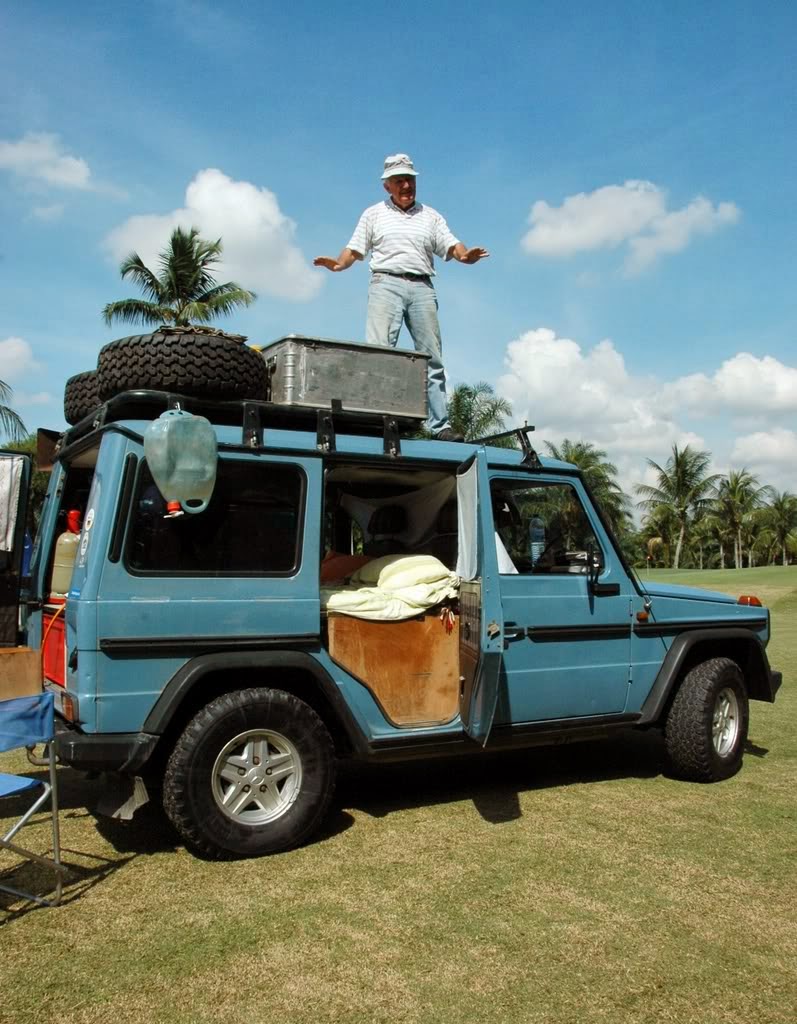
Gunther Holtorf (right) and his son Martin with 'Otto', the Mercedes-Benz G-Wagen that has travelled nearly 600,000km across every continent.
In the past couple of months, they have driven from Pontianak, Kalimantan, across the border into Sarawak, where they spent a few days exploring Kuching before motoring north-east to the Niah caves, on through Brunei and into Sabah.
After enjoying a memorable visit to the Sepilok orang utan sanctuary near Sandakan, the Holtorfs returned to Miri, Sarawak, where the 4X4 vehicle they have christened “Otto” was loaded into a container to be shipped to Port Klang.
Now that Otto is safely ashore on the peninsula, father and son are on the move again, heading towards the East Coast before turning north towards Thailand and, eventually, Cambodia. After visiting Angkor Wat, they will head back to Singapore, from where the vehicle will be shipped to Dubai for the next chapter in the odyssey.
The boxy 19-year-old Mercedes plays a major role in the Holtorfs’ adventures, serving not only as a reliable means of transport but also their home away from home. At any moment, their address is a set of co-ordinates spelled out by their GPS (global positioning system).
How Gunther sleeps in Otto.
“The G-Wagen is old but, mechanically, it is simple, and totally reliable,” Holtorf relates. “From my experience in the aviation industry, I’ve learnt preventive maintenance, meaning I replace wear-and-tear parts according to a schedule rather than wait for them to fail. Over the years, it has hardly given us any problems.”
The vehicle is nearly completely stock standard, with the only major modifications being a pair of 60l “belly tanks” that, together with the 100-litre main fuel tank, give a range of around 1,500km, heavy duty springs and shock absorbers to cope with the all-up weight of over three tonnes.

Even Garmin's museum curator doesn't
know much about this device.
Holtorf's faithful navigator is an old Garmin GPS 75, a unit so old that he says even the manufacturer's present staff don't know much about it.
The list of must-have items stowed away on the G-Wagen include around 400 spare parts that weigh around 350kg.
The rest of the weight comprises everything the Holtorfs need to sleep, cook, eat, drink and even shower in or around the car.
In kind weather, they sleep outdoors on hammocks with one end tied to the vehicle and the other to a tree. The alternative is a cosy “double bed” built into the cabin of the G-Wagen.
“We don’t stay in hotels and we don’t eat in restaurants,” says Holtorf, who politely declined an offer by DaimlerChrysler Malaysia to put them up at the posh Saujana Kuala Lumpur hotel.
Having followed the Holtorf’s exploits closely over the years, Mercedes-Benz has expressed keen interest in acquiring Otto for the famous automotive museum sometime in 2009, when the couple plan to pull up the handbrake for the last time.
By then, the Holtorfs will have driven across so many countries that it’d be easier to name the few they miss out – “Vanuatu, Fiji, the Solomon Islands … those tiny islands in the Pacific that are so remote it’s not feasible shipping Otto there just to drive on the few kilometres of road they have.”
One notable absentee on the list is Timbuktoo, the one place that anyone who has been to can claim to have been everywhere.
“We were in Mali some years ago but the Timbuktoo area was not safe for travellers then,” Holtorf said. “But we plan to return to the region before we end our travels in 2009, and we hope to visit Timbuktoo.”
Three years ago, the company had the Holtorfs’ vehicle shipped back to Germany for ceremonies to mark the 25th anniversary of the G-Wagen, which has earned an impeccable reputation for capability and reliability in both civilian and military service all over the world.
Aside from that, Holtorf insists on paying for everything out of his own pocket.
“I don’t want sponsorship because sponsors will want something in return, such as publicity,” he explains. “In some of the rougher places we’ve been to, we don’t want to attract attention … that’s why Otto is not plastered with stickers.”
While the slab-sided G-Wagen has long been respected for its ruggedness and offroad prowess, it has never been regarded as a thing of beauty.
Even by the boxy standards of its G-Class siblings, Otto is plainly, well, plain. Its drab paint job is best described as an insipid, pallid blue and, Holtorf says, the dull colour was deliberately chosen with that in mind – to keep the lowest profile possible.
Anonymity and humility is the best way to avoid trouble in areas where trouble tends to find you, Holtorf learned from his years in Africa.
He recalled one of their scariest experiences in a lawless part of Ethiopia “where everyone carries a Kalashnikov (rifle)”, when their vehicle was surrounded by a band of rough-looking tribesmen who seemed intent on making trouble.
“I just stayed calm, and tried to get them to calm down … after a while, we gave them some money and they were satisfied and went away,” recalls Holtorf.
So, if one has 17 years of free time, what else does it take to go see the world?
A rugged, reliable, mechanically simple 4X4 vehicle is a good start. You’d need money for a carnet – an international passport for a vehicle – which costs Holtorf a deposit of 5,000 euros (RM23,000).
“The biggest expense for us has been fuel,” said Holtorf. “Aside from that, living costs vary … it’s very cheap in Africa, about 400 euros (RM1,840) lasted us a month, expensive in Australia, and most expensive in Europe!”
Now that I know, I’ve got to get back to work and start saving up.

Latest: They're still at it, 800,000km and counting ...

Catch up with Gunther & Otto, if you can

Don't modify it, replace parts BEFORE they break, and you should not have any breakdowns.