Sunday, 16 November 2014

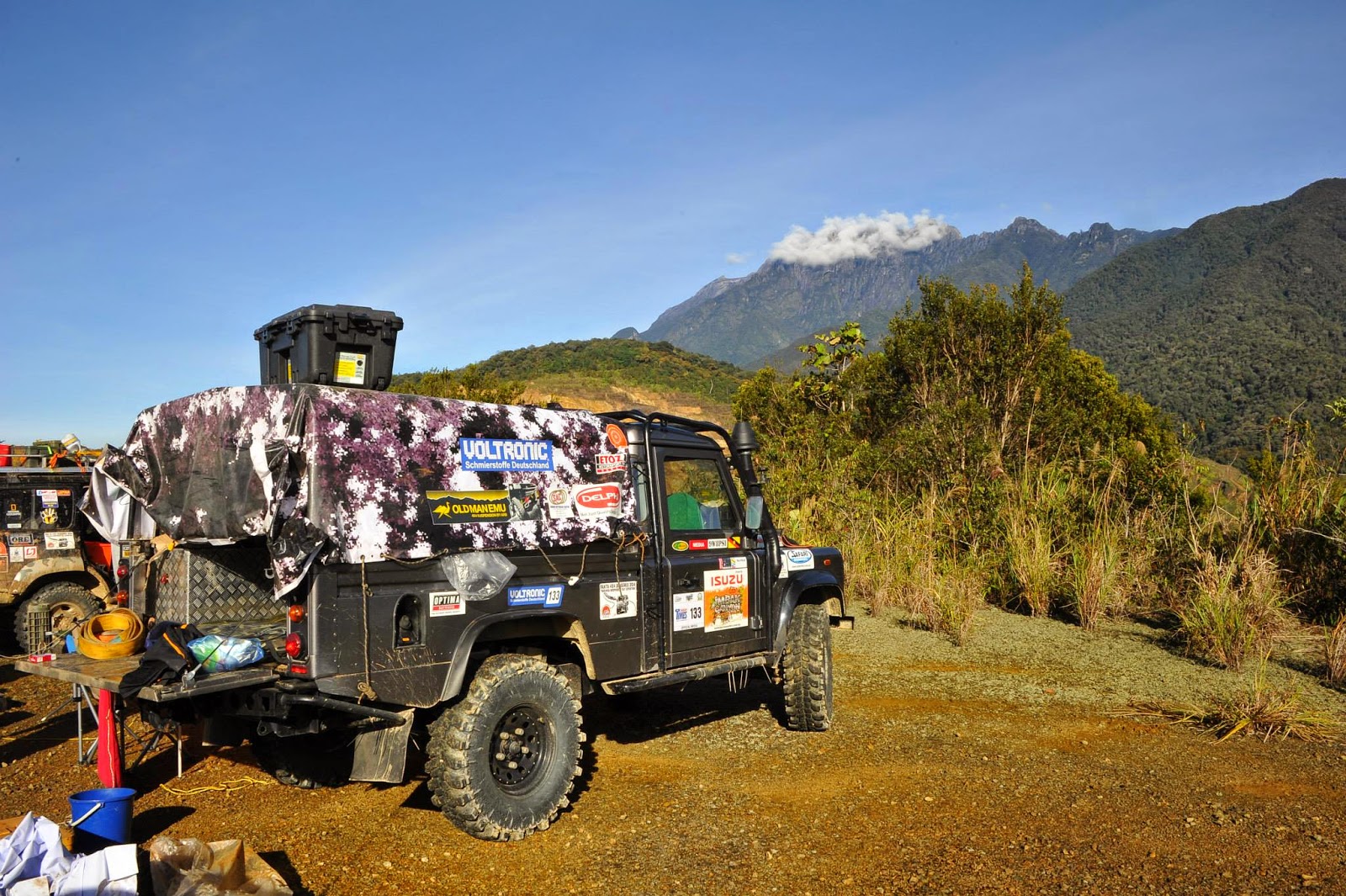
Earth, Winch & Fire (and Water) - The Elements of Borneo Safari 2014


ALL the elements came together to make Borneo Safari 2014 a classic. It did not start off that way, although veterans might argue that a slow, disorganised, chaotic (and, dare we say ... BORING?) start is also part of Borneo Safari's many cherished traditions.
After some bold venue and format changes in the past couple of years, the flag-off returned to the Sabah Tourism Board building in Kota Kinabalu's Gaya Street. It was bustling and crowded, which emphasised and amplified the scale of this year's record participation of 270 vehicles in Sabah's, and indeed, Borneo's, premier 4X4 event.
A couple of years ago, the entry list neared 200 (or was it just over 200?) cars, which led to some mutterings about traffic jams in the jungle despite the magnificent scenery of the route and overall praise from participants, and the 240 or so last year also raised concerns about whether the Safari was getting too big, too popular, and a victim of its own success. Well, it certainly seems to be getting more popular with each passing year.
After being duly flagged off by Sabah Tourism Minister Datuk Seri Panglima Masidi Manjun and other dignitaries, the convoy departed the state capital for nearby Sepanggar Bay, where the first competitive special stages (SS) were to be held.

A Slow Start
With so many cars to get safely into the jungle and the first night's camp site near Kota Belud, there was no time for dallying so most participants did not get to witness the action. This was another departure from the Borneo Safari of old, which was centred on the competition.
Thanks to the modern wizardry of Facebook and Whatsapp, the actual Safari participants followed the competitive action through photo and video updates posted by others and shared instantly around the world.
Anyone with a connected phone
could see more of the Borneo
Safari action than the participants.
So, "did you know the Sandakan car rolled on SS2?" was answered with "ya bah, my friend Whatsapped the pictures".
Anyone anywhere, as long as they have a smart phone (and who does not have one these days) can follow the action almost in real time, except actual Borneo Safari participants who have headed into the remote interior, out of phone signal range.
GPS tracks had been used to guide the participants since a couple of years ago, with limited success, and the failures continued this year. With an overly complicated arrangement that require following detailed, counter-intuitive instructions, it was not long before calls of "help, we're lost" started going out. And this was not even six hours into the event.
Then, the first real problem cropped up. A mild-mannered stream that we had to cross had been swollen into a raging, impassable torrent by heavy rain upstream. Many cars had to turn back and new plans had to be hastily made.
After a detour, original hard-core track and designated camp site of Plan A had to be abandoned. The various groups had to improvise and find whatever makeshift campsite they could for the night, hopefully before it got dark.
This was not a source for complaints, though, because it is accepted that in the Borneo Safari, Man can plan all he wants, but Nature has the final say.
Even though it was disappointing at the time, the decision to backtrack would turn to be a wise one a couple days later, with the most dramatic proof that high water could be one hell of a challenge.
If Day One had gone according to plan, everyone would have their craving for 4X4 action satiated already before emerging near the town of Kota Belud to face a 380-kilometre drive on tarmac up north to Pitas and then down south to Kota Marudu and on to Telupid, near the centre of Sabah.
But without the original track and campsite, it meant two days and over 480km (including 100km on the first day) of driving, there was still no sign of mud, and no opportunity to engage even 4 High, much less 4 Low!
The briefing for the media group on the morning of Day 3 brought no joy. "No off-roading today," media chief Hilary Francis announced. Some groaned silently while others were not so silent.
After refuelling and following directions for some 15 kilometres, a left turn brought some hope. It was a dirt track. Not quite what everyone had been preparing a whole year for, but at least it was not tar-sealed.

Ini Kali Lah!
Then, a stream crossing. A proper, Sabah-style fording under the brilliant sun, no less.
Then, it began. Hard Core! A mud hole, as deep as one dared hope for, full of gloriously brilliant orange mud.
The inaccurate briefing had caught many people off guard, wearing sandals and slippers which were totally inappropriate for the serious work ahead so there was a frantic rush to change into the proper footwear and attire. Nobody complained about the misinformation, they were simply to excited and not a little intimidated by the rough terrain ahead.
It begins!
This, finally, was the Borneo Safari we had come for, that we had looked forward to all year. For the first-timers, this was beginning to look like the stories they had been hearing about from previous editions. "Ini kali lah!"
Thus, began the low-gear crawls, the optimistic charges, the shouts and the frantic gestures. Out came the gloves and the winch cables, and the snatch blocks.
One by one, the cars went into the thick gooey mud and the drivers tried their best to bulldoze through to the other side, only to be foiled and had to be dragged out with varying degrees of difficulty.
Occasionally, someone like Brunei's Shamsuddin Zai would succeed in powering his way through to resounding applause and cheers. But the monster ruts he created in the process ensured that such success was few and far in between.  
Shamsuddin "Nissan King" Zai powers through ...

Be Careful What You Wish For
We certainly got our wish. The rest of the the day was spent slowly and painfully negotiating the multiple obstacles that lay ahead. More mud holes, steep and slippery ascents and descents, all the essential ingredients of a classic Borneo Safari were served up, one after another.
It was not long before the tough going took its toll on the vehicles, with mechanical failures occuring at the very first mudhole.
A broken driveshaft here, a shattered pinion gear there, an entire axle ripped off, a tyre puncture halfway up a treacherous slope, burnt-out winches or broken ropes or cables, all these more were occurring at a furious pace up and down the convoy.
In the afternoon, it poured. What was already a difficult track became a Herculean challenge.
It was teamwork that got each car through, slowly, painfully, an inch at a time, then a foot.

High Water
By late afternoon, the various groups had become mixed up and the convoy stretched over many kilometres.
The lead element of the media group, comprising four vehicles, reached the biggest of several streams in the Tawai area about 3.20pm and forded the clear waters without drama.
When the main body arrived less than half an hour later, the water level had risen considerably and it was beginning to look dangerous.
Media chief Hilary had misgivings about making the crossing but information from some participants bathing in the stream indicated it might be safe to attempt.
It would prove to be a mistake, as the strong current pushed his Trooper off-course in mid-stream, and a desperate and urgent rescue effort had to be mounted, with no time to waste. (See separate story)
Fortunately, everyone aboard was saved and all ended well, other than the 15-hour soaking that the car had to endure before the raging waters subsided sufficiently for a salvage operation to be carried out.


Earth and Fire
Not everyone had the same level of adrenalin and drama. One group missed the junction and ended up wandering on tarmac for another long day, and then spent an even longer day waiting for the others to catch up with them.
Then, just as they were about to have some fun, a Nissan Patrol from Brunei was brought to a screeching halt by a wheel bearing failure.
Mahmood "Komando Hangus" Omar and his charred car.
Mahmood Omar had to rely on a buddy to drive him over five hours to Tawau to look for a replacement part, and endured another five hours back to his stranded car, only to discover it had caught fire while he was gone. A wiring fault and subsequent short circuit was the suspected culprit.
There was not much else left for Mahmood to do except accept a tow from his buddy but his tales of woe were not over. The towing vehicle's tyres threw up rocks that shattered his windscreen.
But all these have not damped the enthusiasm of Mahmood, now dubbed "Komando Hangus" (burnt commando) by his friends. He has vowed to return for Borneo Safari 2015, better prepared than ever.

Imbak Canyon
The official destination for Borneo Safari 2014 was Imbak Canyon,  a forest conservation area famous for its wide waterfall. Sadly, most participants never got to see this spectacular wonder of nature. Only a handful of official and media vehicles were allowed into the conservation headquarters area because of space constraints so we will have to be content with their offical photo of what we missed.


Here Be Elephants
The rest of the convoy moved on to the oddly named Camp Hitachi (because it is identified by some abandoned Hitachi brand machinery, apparently) for a two-night stay.
A pair of exhausted competitors from Sarawak pulled over at the side of the track for a brief rest and promptly fell asleep.
When co-driver Tze Kim woke up, he nudged his partner Jack Then and asked: "Are there elephants in Sabah?"
His drowsy buddy wondered why he would come up such an odd question, whereupon Kim replied: "Because there is one looking at us."

Earth + Water = Mud
Jack Jones from Kuching enjoying the mud.
The journey from Camp Hitachi back out to Lahad Datu and civilisation would prove to be everything that 4X4 aficionados could wish for, and then some.
Winching, more winching, more mechanical failures, tyre punctures, flat batteries, and more. Much more.
Some of the bigger vehicles that had attracted admiration at the start line were now beginning to inspire dread rather than awe because their weight was proving to be a severe impediment to progress.
While the lighter vehicles could winch themselves through the quagmires, the massive beasts, some of them crippled by broken drivetrains, needed multiple lines from several of the most powerful winches available to coax them out.
Suffice to say, everyone was relived when the hard core stuff ended. Much as we enjoyed deploying the equipment and practising the skills, there came a point when enough was enough. And we had had enough.
The rest of Borneo Safari 2014 would prove to be a breeze as we took in the sights of Lahad datu, Ranau and the abandoned Mamut copper mine, and an ample opportunities to catch up with our fellow travellers under more sociable circumstances, and a good time was had by all.


Sunday, 9 November 2014

Come Hell or High Water - Drama at Tawai (Imbak Canyon)


When things go wrong, events often happen so fast that most people do not know what to do. They need time to think, to figure out what is the best course of action, to work out a solution.
Only, there is simply no time. Faced with such a crisis last week, Michael "Mike" Jose did not waste a moment. He grabbed a winch cable - literally the only lifeline around - and plunged headlong into the raging torrent.
His was the first life at risk, and he laid it on the line because his friends were in danger.
The stream less than 30 minutes earlier.
Barely half an hour earlier, I had driven across a calm stream, with water so clear we could see the smooth stones lining the bottom. It was 3.28pm, according to the EXIF data from photos and videos I took while fording the shallow water. 
The location was N 5.459667 E 117.159667, a place called Tawai, about 19 kilometres south of Telupid town.
It was October 28, Day Three (of eight) of Borneo Safari 2014, a planned 1,300km trek that had taken us thus far north from Kota Kinabalu to Pitas and Kota Marudu, and back south to Telupid.
There had not been much action in the first two days, only a lot of tarmac, and there were already rumblings of discontent about how boring the event was turning out to be. We should have been more careful about "what you wish for ..."
By the time panicky and frantic shouts over the VHF radio drew me back to the scene, Hilary "Alee Boy" Francis was in deep trouble.
I grabbed my camera and snapped the first shot of the unfolding drama at 4.07pm.
Hilary's Trooper was stranded in the middle of the stream, now swollen by heavy rain upstream into a ferocious, life-threatening monster. He was not alone as his wife Lynn was in the back seat, and Isuzu Malaysia manager Azhar was in the front passenger's seat, all of them with water up to their chests. And the water level was still rising, rapidly.
There was a lot of shouting among the crowds that had gathered on either bank.
Then, Mike picked up the winch cable and dived into the swift current. He was swept away almost immediately but had planned his path correctly and was pushed up against the quickly sinking vehicle. Ignoring the pain of being buffeted by swift water against hard steel and on the verge of drowning, he managed to secure the steel wire rope to the wildly rocking Trooper. 
There was now a glimmer of hope for the vehicle's three occupants, plus Mike himself, by now also stranded in the middle of the angry currents.
Meanwhile, the Isuzu's soaked electrical system began shorting out, winding up Hilary's power window as he tried desperately, fruitlessly, to keep it down. At one point, the wipers started sweeping the windscreen, all on their own. 
The danger was far from over. While the single winch line was able to prevent the car from being swept downstream, the current still threatened to topple it on its side. 
By then, enough time had passed for plans to form, and a light nylon line was successfully thrown from the far bank out to the trapped occupants, who then used it to pull a second winch cable anchored to a vehicle on that side.
With two cables, one on either side, the situation stabilised a bit. The tension of the two winches had to be adjusted constantly to prevent the car toppling over as the current pushed it one way, then the other. 
But the water level was still rising fast and soon, all four people were up on the roof of the car.
All hopes of winching the vehicle to safety faded, and thoughts now turned to saving the four lives.An empty jerry can was turned into a makeshift life preserver, used to throw a line out to the trapped people.
It was not easy but after some hairy misses, all four were eventually pulled to safety, soaked and shivering but alive.
Mike was not the only one who rushed to assist, there were many others who also helped to rig up the cars, lines and other equipment without which success would not have been possible. 
But it is clear that his role was critical to the rescue. If he had not made the initial plunge when he did, the rest would not have mattered. And, by the time the others went into the current to help, they at least had a safety line to cling to, the line that Mike had swum out to attach earlier.
The water continued rising until the Trooper's roof was all that could be seen. There was not much else that could be done except to prepare some hot food and drinks for the survivors and get them into dry clothes.

The unfortunate Trooper remained submerged a further 15 hours until 7.30am the following morning, when the river had subsided enough for it to be pulled onto dry land.
Eager hands got to work and within a few hours, all the water had been drained, oils changed and it was running like a Trooper again. The show must go on.
Hilary is safe but helpless to save his car.
There was another twist in the tale, towards the end. When every official and participant gathered at the Hakka Hall in Kota Kinabalu on the evening of Sunday, November 2, to celebrate the conclusion of another successful Borneo Safari, Mike was not present. 
When he should have been feted as Man Of The Hour, indeed of the entire event, for his heroism at Tawai, a series of miscommunication ended up with him not having a ticket to attend the official dinner, even as many groups reported that they had extra tickets because some members could not attend. Something must be done to put right this sad turn of events. 
Mike George Awa is a 26-year-old Lun Bawang from Long Sukang, near Lawas, Sarawak. He is an experienced mechanic whose resume includes supporting the Japanese team that competed in previous Borneo Safaris.  


Monday, 13 October 2014

So, where is the Government fuel subsidy that everyone is talking about ...

Sorry folks, have not been posting stories of late. No excuses, just did not feel like writing. Now, I have something to get off my chest.
So, tell me again, where is that fuel subsidy from the Government that everyone is talking about?
You buy a car, below 1,800cc like most people, because that is all you can afford. Let's say it rolls out the factory gates priced at RM40,000. 
At that price, a fair profit has already been made by the factory, sufficient to pay for its factory rental, equipment amortisation, suppliers, employees' wages, etc. All fair enough.


Don't take my word for it, see it for yourself here: http://www.maa.org.my/info_duty.htm


The Government has been kind enough to do away with import duty from Asean nations, in the spirit of cooperation and all that.
It now takes just 75% in excise duty on your sub-1,800cc car. That's RM30,000.
So, it reaches the distributor at a cost of RM70,000 plus transport and miscellaneous charges. The distributor, and the dealer down the line, have to make a profit to cover their costs and, simply because they are in business to make a profit. Fair enough.
Say, they mark up 15% of RM70,000, which brings the price to RM80,500.
The taxman is not done yet. He takes a further 10% in sales tax. That's RM8,050, which pushes the price to RM88,550.
When you pay RM88,550, remember that RM38,050 (that's roughly 43%) of the car's price is already in the Government's pocket.
Then you drive for the next 15 years. Car companies calculate warranties based on an average annual usage of 20,000km. So, you drive 300,000km. At an average of 8l/100km (a decent, not so great, not too bad fuel consumption for a 1,800cc car), you burn up 24,000l in 15 years.
Now, the Government already has 3,805,000 sen of your hard-earned money (which has been already income-taxed, by the way).
Forget about complex compound interests and overnight rates the Government can earn from holding YOUR money over 15 years, that amount can subsidise YOUR 24,000 litres of fuel at 158.54 sen per litre.
Now, I quote from The Star Wednesday August 20, 2014 MYT 12:00:00 AM , i.e., before the latest round of oil price drops and subsidy rationalisation, (http://www.thestar.com.my/Business/Business-News/2014/08/20/Multitiered-fuel-subsidy-good-for-Malaysia-says-economist/): "As of July 2014, the actual price of RON95 petrol was RM2.85 and diesel RM2.71. The flat rate subsidies of 75 sen per litre for RON95 and 71 sen per litre for diesel are extended to all private and commercial vehicles."
You earn an income, you pay income tax. That pays for the country's services to you. You pay road tax to use the roads.  You pay toll to use some other roads. You pay sales tax to pay for the Government's expenses. You pay excise tax some more ... For what?
So, remind me again, where is the "fuel subsidy by the Government" that everyone is talking about? It looks like WE are subsidising the Government after all.

Friday, 13 June 2014

I am getting a new Land Rover ... umbrella!


Yay! I won me an umbrella! Not just any umbrella, but a genuine Land Rover All-Weather Umbrella.
I'll think of it as my latest Defender, the one that defends me against the elements, like the sun, and the rain, and the wind.
Thanks to Land Rover Defender Malaysia's Facebook page for running the contest.
Here's what was required:


Here's my winning entry, taken during a trip to the Bario highlands of Sarawak:

A misty morning in Bario with Sarawak 4X4 veteran Richard Voon.


Here's my other entry which did not win, but which I actually prefer:


Here's why I am looking forward to the most useful prize.


Thursday, 12 June 2014

Not quite Borneo Suffering, but still Drama kot


When Sabahans tell you that a 4X4 expedition is "hard core", believe them. When they say the next trip will be super hard core, be afraid. Be very afraid. Especially if they invite you to go along, and you're freshly out of excuses to decline.
For years, I've been hearing about this place called Deramakot. Whenever Sabah Offroad Adventure Association (SOAA) members get together and the chat turns to how tough a just-ended trip had been, it crops up, "have you been to Deramakot?" It means "you don't know what tough is till you've done it."
If you have been, then the recent event is compared to Deramakot. If you have not, you shut up and listen to the veterans' tall tales about winching 30 times to get up one hill. About taking a whole day to cover one leech-infested kilometre, about having to drag along crippled and broken-down vehicles when even the best-equipped, fully functioning Land Cruisers find the going torturously slow.
And the SOAA has a couple of RTM-made videos on YouTube to back up their claims.
Deramakot Forest Reserve comprises 55,139 hectares of mixed dipterocarp forest located some 160km south-east of Kota Kinabalu and 90km south-west of Sandakan.
Within its boundaries, there are several disused logging trails that can be explored with suitably-outfitted 4X4 vehicles, with prior permission from and under close supervision by the Sabah Forestry Department.
Over the years, these trails have provided a suitable challenge for many expeditions big and small, including the annual Borneo Safari organised by the Kinabalu Four Wheel Drive Club (now evolved into the Sabah Four Wheel Association).
In January last year, the SOAA mounted its first expedition to Deramakot, dubbed "Survival Of The Fittest" that apparently lived up to its billing, and then some. They're still talking about it.
Like a good horror movie, the tales are both scary and irresistible at the same time. The hard slog that went on day and night as the rain hammered down incessantly, and the numerous obstacles that broke even the toughest vehicles, should have been enough to deter any sensible person from attempting the trek again but, like a flame draws a moth, the stories only drew even more 4X4 aficionados to Survival Of The Fittest II.
"Our members have been clamouring for a return to Deramakot, especially those who missed out on the first round last year," said SOAA president Hiew Min Kiyun.
When they invited this writer to go along, the reaction was definitely one of mixed feelings. The experience would be welcome, as would the bragging rights as a survivor of Deramakot. But, being more of a leisure, cold beer and camping kind of guy, did I really want to suffer for three days and two nights? Well, the pull was strong, and the push was that I had run out of excuses.
Hopping into the Land Cruiser 80 Series, the legendary "Ninja Turtle" of Expedition Leader Alvin Leong and co-driver Vivian Julip for the 200-plus kilometre drive from KK through Kundasang and Ranau to Telupid, I was treated to more war stories from the previous year's trip.
After turning off onto the unpaved track to the forest reserve, there were hints that this year's event might be less stressful, even if just a little.
The local weather had been dry for some time, and the dusty road had coated the grass and oil palms that lined the70km route with a thick layer of orange-brown dirt. Anyone who has experienced off-road driving would know that the difference between a dry and a wet track can be huge.
But, just after the convoy arrived at Sabah Forestry headquarters and set up camp, the rain began. Game on! Maybe. The shower did not last long.
After dinner, the participants were required to attend a briefing by the forest rangers on the Deramakot Forest Management Unit's reason for being and the many do's and don'ts for all visitors, especially the strict rules on trash - everything brought in, even cigarette butts, must be taken out from the jungle.
The repairs begin ... after less than 1km.
Action began early the next morning when the convoy encountered a deep V-gulley just 800 metres after turning off the road and winching started in earnest and the first leeches showed up.
The first mechanical problems cropped soon after, with a ruptured air intake hose signalling that the vehicles were in for a pounding.
The horror stories of the previous trip had inspired all car owners to check and prepare their vehicles meticulously but Deramakot seemed determined to live up to its reputation, even if the sun was blazing down at that early hour.
This was going to be a contest between Man and machine on one side, and Nature on the other.
The trail had not been traversed by vehicles in over a year, and was thickly overgrown.
And here they come ...
The 4X4s had to force their way through grass and other plants that were as tall as a man, while branches and bamboo reached out from the sides to claw at the passing vehicles.
At times, it sounded like a bunch of unruly children were whacking the cars with sticks while others were scratching blackboards with their fingernails.
From then on, it was hard going but not super hard core. There was no rain. The ruts were deep, the hills steep, but no rain. Progress was slow at an average of about 5km/h, but that's fast compared to a kilometre a day of previous Deramakots. Because there was no rain.
It was still very much a hard core event, with lots of winching and breakdowns but, for the well-prepared cars and participants, not the ultimate hard core event that had been anticipated.
By day's end, the convoy had covered about 12 kilometres of the 20km trail before stopping to set up camp and fend off the few leeches that showed up.
The next day served up some mud pools and fallen trees but everyone made it out in good time and camped in relative comfort at the "White House", a bungalow for the staff of Deramakot.
The third night that had been allocated for the event was spent at Mesilou, about 5,800feet above sea level up in the Kinabalu highlands, where the freezing temperatures were a welcome change from the windless heat and humidity of Deramakot jungle.
While everyone was glad to be out without too much human suffering and damage to vehicles, many participants were left with a feeling of unfinished business.
While it was still a Drama-kot, it was not quite the "Borneo Suffering" we had anticipated. There is a need for a Survival Of The Fittest III, preferably during the wet season. But at least I am now ranked among the Fittest!


Human ballast to prevent a 3-tonne beast toppling into the mud pool.

A cry of "pacat" (leech) is enough to get squeamish types to drop their pants!


About Deramakot Forest Reserve


Map courtesy of Sabah Forestry Department.


There are logging trucks in Deramakot Forest Reserve. Because there are loggers. Yes, they cut down trees. No, it is not a mistake, nor is it a blatant disregard of regulations.
The reserve's raison d'etre, its reason for existence, is to conserve the natural resources, not to preserve. While it may be puzzling to first-time visitors, there is no confusion among those rangers who serve.
Deramakot is billed as a "well-managed forest" to be used and exploited responsibly for the benefit of the state and its people, not a virgin jungle to be preserved.
According to www.deramakot.sabah.gov.my, it was created in 1989 when the Sabah government realised that the state's forests was being depleted, including Deramakot. With help from the German Agency for Technical Cooperation (GTZ), it developed a management system aimed at responsible production of timber for logged-over forests.
The goal is "ecologically and scientifically acceptable forest management ... the intent is to manage the commercial forest reserves in a way that mimics natural processes for production of low volume, high quality, high priced timber products in a sustainable manner.
"Sustainability is defined in terms of balance nutrient cycles, forest structure, biodiversity, forest function and socio-economic needs."
"DFR will be managed under sound forest management practices in accordance with the biological, social and economic principles defined by the International Tropical Timber Organisation (ITTO), Malaysian Criteria and Indicators (MC&I), and in conformity with the existing State forest policies, environmental policies, legislation and regulations."
At the briefing for participants of SOAA's "Survival Of The Fittest II", the senior ranger said that selected trees were harvested by appointed contractors who are paid for their services while the logs are auctioned off to the highest bidders. The proceeds go to the state and are used, among other things, to pay for the upkeep and protection of the forest reserves.
The local communities living nearby are also looked after through a committee called the "Deramakot Social Forestry Committee (DSFC)". Periodic consultations with the local communities are held every 4 months.
There are no communities inside the reserve, but five villages (each comprising 20 - 50 households) located on the southern fringe of Deramakot FR have been identified.
The stated goals are to provide training and developing skills such as producing functional and decorative handicraft to ensure local communities of a livelihood; provide basic amenities such as clean water, school, etc.; and to create jobs, in line with the government policy to eradicate rural poverty.
Wildlife is also protected, with about 75% of mammals in Sabah found in Deramakot, which is a key habitat for five globally threatened large mammals: Orangutan, Pygmy Eephant, Tembadau (Banteng), Proboscis Monkey and Clouded Leopard.
Eco-tourism, defined as "responsible travel to fragile, pristine, and usually protected areas that strive to be low impact and (often) small scale (as an alternative to mass tourism)", is also encouraged.
Its purpose is to educate the traveler, provide funds for ecological conservation, directly benefit the economic development of local communities.
Hence, events like the 4X4 adventure organised by SOAA and earlier Borneo Safaris (by the Kinabalu Four Wheel Drive Club) are welcome, with strict conditions and, of course, payment of fees.
The visitors must be accompanied by forest rangers who ensure that all rules, especially those governing cleanliness and wildlife protection, are complied with at all times.


Tuesday, 14 January 2014

It Was A Dark And Stormy Night

It was a dark and stormy night. (I always wanted to start a story with that!) But it was really a dark night, at least. And it was raining. And there was a little lightning. So, yeah, a dark and stormy night it was on Jan 5, 2014.
My phone rang. I was not expecting any call. It was Alvin. He sells Fords for a living, and drives a Mitsubishi Triton. Why would he call me on this dark ... evening?
I pressed the green phone icon. "Hello?"
Alvin asked where I was and, before I could answer, launched into an excited stream of words that I could barely make out.
"Calm down, Alvin, I'm at home ... Bau, now tell me, slowly, what's going on."
The short version, he was also in Bau, at his wife's kampung, about 35 kilometres from my home. He had driven into a rubber estate to explore around 4pm, then decided to turn around when it started raining.
The track had become slippery very quickly, his Triton slipped off the track on its left side, coming to rest against a rubber tree. That tree propped up the truck and probably saved it from tumbling down the slope.
He needed rescuing. I was the nearest person he could contact who had a mission-ready 4X4, my trusty Borneo Safari veteran Land Rover Defender 110 HCPU (Hi-Capacity Pick-Up).

Not the best photo ever, but I was on a rescue mission, not a photo safari.


The game was afoot. Grabbed appropriate shoes, raincoat, hat (I did say it was a stormy night, didn't I) torch, straps, shackles, checked that remote control for the Warn 8274 was in the car, all good to go.
With the benefit of hindsight, should have also grabbed the handy VHF radio to go with the car-mounted mobile set, and extra torches. But I didn't. Managed without but would have been easier with.
Also, made a phone call to another buddy, Chai Yew Foo, to let him know what was happening. This was Plan B, always good to have back-up. He "rogered" and said he and his Landy Double Cab (DCPU) would be on standby. A quick post on Facebook mobile would also alert the local 4X4 community in case more help was needed later.
Road being wet and everything being dark, I drove cautiously and got to the Kg Stass junction about 45 minutes later, met up with Alvin and went to see about rescuing his stricken truck.
It was not that far from the main road, less than a kilometre.
After descending a mild slope to get to the site where the Triton was leaning against a tree, I hooked up the winch to his front recovery point and began reeling the plasma rope in.
No good, it only pulled my Defender down towards his truck.
Unhooked rope, drove in a little further and managed a tricky three-point turn and then tried to climb back up the slope.
The rain had turned the surface of the clay trail into a slick grease-like layer. There was no traction to be had, even on GT Radial Komodo MTs, which had proven quite competent in most other conditions.
A ditch running diagonally across the track ruled out a run-up to build up momentum for a charge up.
So, the plan evolved into a winch-up for the Defender, using a longer (8-metre) strap to tie the Triton to the Landy's rear bumper.
After three cycles of winching and relocating anchor point, I was sure that Alvin would be able to drive up on his own since the Defender no longer needed winching, it could climb under its own power.
But, no joy, his tyres just spun uselessly while the Triton swayed side to side. It was really slippery, and footing was treacherous for humans as well.
Only then did it occur to me to ask Alvin; "What tyres are you using?"
ATs, came the reply from the darkness. Ahhhhhh so. All Terrain tyres, a highly optimistic name.
Around this point, I really rued forgetting to bring the extra radio. It would have made communication between Alvin and me a whole lot easier.
So, the winching continued until the two-car train reached level ground.
Tired, thirsty, wet and very muddy, we had made it. The phone rang again, and it was Foo and another buddy, Keith, asking where we were and how things were going. They were on their way to our location, about five minutes away.
We waved off the cavalry, all was well and made arrangements to meet up for celebratory drinks at Bau town, about 20km away, after a quick clean-up at the Petronas station nearby.
And so, all was well that ended well. Alvin is looking for better mud tyres.
Now, if you'll excuse me, my phone is ringing ...


Sunday, 29 December 2013

An Uplifting Experience

You want? Can, only RM200,000, and wait one year. Oh, basic truck not included, you have to supply your own. This fabricator is in the outskirts of Bangkok, Thailand.

I am writing this in response to several requests and queries from friends who asked about methods to make their 4X4 vehicles taller. I am neither an engineer nor a mechanic, and can touch only on some theory and my own experiences, good and bad, as a guinea pig. So, be warned, proceed at your own risk. Some of the points and principles that will be touched on would be conveyed best with diagrams and other visual aids but I don't have the skills and tools to create them so words and your imagination will have to suffice.


Think "Big Foot", think "COOL!" So, tall 4X4s look good. The bigger the tyres, the better the truck looks. (Note, the word "truck" is used here as an affectionate term for all 4X4s, not just the 4X4 pick-ups that have become popular in recent years.)
Being tall has real advantages when you go off to play in the rough stuff. Keeping the body high up, away from the mud, is the best way to ensure progress. Being low, it is all too easy to be stranded with your truck's belly sitting on the mud (or sand), with all four wheels spinning futilely. When you are like a beached whale, all traction aids like diff lockers and electronic traction control become useless.
The most effective way to gain stature is to fit bigger tyres. By "bigger", I mean the tyre's diameter. Of course, the bigger tyres tend to be wider as well, and it's the wider or fatter tyres that have come to be associated with what looks good on a 4X4.
The first problem encountered by anyone who has tried to fit tyres substantially bigger than standard is that they are too big. If you're now thinking "duhhh ...",permit me to elaborate.
Larger tyres will hit or foul various parts of the vehicle's bodywork, especially up in front, where the tyres actually have to turn left and right to steer, as well as rotate and move up and down as the suspension flexes.
The problem then will not just be irritating noises, it will eventually lead to parts getting damaged or destroyed.
The typical 4X4 pick-ups come off the showroom floor fitted with tyres that range from 28 to 30 inches in diameter. Don't bother with calculating from the width and aspect ratios, just take a measuring tape or long ruler and measure yours to find out exactly what diameter it is.
Generally speaking, you should be able to upgrade to tyres up to 31" without any major modifications. Depending on which truck you have, there may be minor issues with the rear edge of the bumper or front mud flaps, which may have to be trimmed or removed, respectively.
Lifted (right) and not lifted.
Aside from increased diameter, wider tyres may also cause problems by touching various parts of the suspension, such as springs or radius arms. You could end up with reduced ability to turn the steering. In the jungle, a simple three-point turn could become a 13-point turn.
The problems associated with increased diameter can be fixed with a lift, and with width, by changing to wheels with a more negative offset (i.e. wheels that stick out further from the vehicle.) Both of these "fixes' will give you an instant improvement in looks, but also, possibly, create problems with driveability and durability of your truck.

BODY LIFT

The first way in which you go about fitting bigger tyres is by lifting the body (or cabin) up from the chassis or frame. This is done by undoing the dozen or so nuts that secure the body to the frame, jacking the body up, inserting lift blocks of 3, 3 or 4 inches in height, then securing with longer bolts, and ... Voila! A taller truck!
But it's really not that simple. Some vital components are attached to the chassis (like engine, gearbox and radiator) while others are fixed to the body (electrical and electronic components and wiring harnesses), and some have one end secured to the body and the other to the chassis (like steering and brakes), so adjustments will be necessary.
The scary mods needed include cutting and lengthening the steering shaft, gear shift lever, transfer case lever, and possibly, replacement of brake lines with longer ones. Failure to do these and do them properly, can lead to issues that are irritating at best, and disastrous at worst. Like total brake failure, for example.
My first experience with a body lift went well because the workshop did a professional job. Several years and a new truck later, I went back to the same shop and got the same procedure done, with different results. Perhaps it was a different mechanic who did the job but, whatever the reason, the steering shaft was not done right and I had to endure squeaking whenever turning the steering, and the transfer case lever had to be adjusted several times before it stopped popping out of gear. Suddenly finding yourself in neutral while climbing a steep hill is not a fun experience.
These days, I'd advocate body lifts as a last resort.

Some of the components needed for an IFS lift.

SUSPENSION LIFT

A suspension lift can be a simple matter of spending money to buy longer springs and shock absorbers, or a very messy, complicated affair with many side effects. The easier ones are usually mild lifts of up to 2 inches (50mm or less).
Almost all 4X4 pick-ups today come with independent front suspension (IFS) and rear rigid axle with leaf springs. A notable exception is the pick-up version of the Land Rover Defender, which employs coil springs and rigid axles for both front and rear.
The latest generation of trucks feature IFS that uses a combination coil spring and absorber (or damper) with upper and lower A-arms (also known as wishbone, like the chicken breastbone), while earlier generations mostly used torsion bars with upper and lower wishbones.
There is no such thing as the best type of suspension, each has its own pros and cons, and the final design is the culmination of the engineers' best efforts to reach the best compromise to meet many different criteria of performance, such as handling, comfort and load carrying.
So, do we want to mess with the work of large teams of the best, brightest and most experienced engineers that the resource-rich car makers can find? Of course we do! 'Cos we want our trucks to look cool!
There is usually a cheap and easy way to do things, and then there is the proper way, which is usually not easy, and certainly not cheap.
One subject from the classroom of many years ago that needs to be revisited is geometry. Most suspension systems involve movement of some components relative to some other components that the former are attached to. That means some form of triangulation, and some pivoting around a pivot point. In simple terms, changing the length of one side of a triangle without altering the length or relative angles of other two sides, is impossible.
About this point, I feel like giving up. It's getting complicated. When talking about the front wheels, we need to consider wheel alignment parameters, like caster, camber and toe, all of which can be affected by simply changing the length of the spring.
To bring harmony back to the arrangement, you'd need to change the length of at least one of the A-arms (usually the upper), and change or adjust the steering tie rods. The objective would be to ensure that the new triangles have the same ratios as the original.
Then, for IFS trucks, there is the issue of the front driveshafts. These are articulated in such a way that, in standard form, they can swing up and down comfortably as the suspension and wheel assembly moves up and down with the terrain. By making the suspension taller, the driveshafts will be tilted downwards (a little or a lot, depending on extent of lift), using up part of the downward flex it has. If the lift is taken too far, the shaft will extend downward to its limit, and beyond. If bigger and heavier wheels/tyres are fitted as well, then don't be surprised if the front driveshafts either pop out or break.
One way to address this is to lower the front axle to a similar extent as the suspension lift, so that the driveshafts are as close to horizontal as possible when the suspension is not flexing. This would require some form of lift kit that includes bits for axle relocation.
At the rear, suspension lift kits for leaf springs usually comprise a block (can be made of metal or some form of plastic) that goes between the leaf springs and the axles, longer U-bolts, and longer absorbers. Again, mild lifts should work reasonably well but taken to extreme, they can cause instability. Just think of running around in sneakers, then wearing 2" heels, and then 4" platform shoes, and you should get the idea.
4X4s with rigid front axles and coil springs have to deal with the same forces but they do it in different ways, and so any attempt to achieve a lift will have to be done in different ways ...

RIGID AXLES 

Newer Land Rover with coil springs, i.e., the Defenders, use a suspension design that is slightly different from others. At the rear, the rigid axle is held on the centre line by an A-arm with a ball joint which allows the axle to move up and down but not side-to-side.
Most other 4X4s with coil springs and rigid axles use a Panhard rod, which does a similar job but does allow some side-to-side movement when under extreme articulation, and also when the vehicle is given an extreme lift.
When lifting an axle held in place by a panhard rod, it is necessary to either replace with an adjustable rod, or relocate one of the rod's mounts so that the panhard rod remains more or less horizontal at rest. This applies to a Defender's front suspension as well because it uses a Panhard rod. With the engine at the front, there is no space to use an A-arm similar to that at the rear.
If these modifications or adjustments are not done, the front and rear wheels may not line up properly with each other, and either or both axles may not line up with the chassis.

TO BE CONTINUED


Monday, 16 December 2013

How Much Torque? Too Much Is Just Enough

How much torque does your 4X4's engine produce? 180Nm? Over 200Nm? That's so last century. Over 300? Now, you're in the 21st Century. Over 500Nm? That's serious. 750Nm? Touareg V10. More, more, more ...


There's no substitute for size when you want to haul lots of stuff around. “No replacement for displacement,” as the Yanks love to say.

So, you want to do some serious shopping? Buying in bulk to save money? You need a big vehicle, then, and they don’t come much bigger than the Mercedes Actros, which may be just the choice for heavy-duty shopaholics.

While the average sedan can probably lug around 200kg or so of shopping without running out of puff, and any self-respecting pick-up can pick up 800kg to a tonne, the Actros hauls up to 80 tonnes without so much as a bead of sweat.

Of course, having a large boot or cargo compartment is just part of the story. Once your bargains have been safely stowed away, the vehicle’s engine needs to have enough grunt to get you and your newly-acquired belongings home.

The average 1.6-1.8l family car can call upon 110-120 horses, and around 160-180 Newton-metres is considered healthy torque for toting loads about. Volkswagen Touareg V10 Diesel, 750Nm.

The Mercedes Actros’ V6 engine pumps out 1,850Nm, and redlines at 2,500rpm. (No, the figures are not typo errors.) If you like horses, it delivers about about 395.  BHP, that is.

I guess you can figure out by now that the Actros is one special vehicle. It is, and even getting into the driver’s seat requires a special technique. You grip the two grab rails provided, climb up the steps and swing your behind into the spacious cabin.


The cockpit is roomy and offers a commanding view of the road ahead and out the driver’s side, but rearward visibility can be awkward, depending on the accessories fitted. The large side wide-angle mirrors do help quite a bit, though.

The high position takes a little getting used to, but anyone who drives a 4X4 will appreciate the advantage of being able to see further. The front seats are designed to be comfortable over long periods while rear passengers get a well-padded seat that’s as comfortable as a mattress (and even looks like one).

The controls are well sorted out ergonomically but, at first glance, there are many more switches and stalks – some with unfamiliar functions – than in most other vehicles. There sure are a lot of gauges and dials in the wrap-around dash.

The gear shifter is a tiny T-bar perched at the tip of the left armrest, conveniently placed for easy operation. Playstation fans will find changing gears a breeze, although choosing the correct gear for the occasion may be perplexing because the Actros has a 16-speed transmission. (That’s right, eight gears multiplied by two because it has a high and a low range.)

The driving procedure is also a bit unusual, and needs getting used to. You select the gear first, then depress and release the clutch lever to get the vehicle moving.

Next, you push the spring-loaded gear lever forward to shift up, and the indicator in the dash shows which gear you’ve selected. But, the shifting is not actually done until you depress and release the clutch pedal, whereupon the gearbox electronically moves the cogs.

If you haven’t figured it out yet, the Actros is a truck. And not just any truck, but one powered by a massive 11,946cc diesel engine! How about that for displacement?


The Mercedes Actros is not the fastest vehicle I’ve ever tried, but it certainly is one of the coolest vehicles and the heaviest I’ve ever had the privilege of taking for a spin.

It’s also a real heavyweight when it comes to bragging rights. Imagine telling your friends, “Hey guys, I drove a truck today!” They’ll probably roll their eyes and wonder what the fuss is all about, with the thousands of 4X4 pick-up trucks all over the place. Then, you show them the picture.

That cute chimp may have had something to do with the popularity of the TV series, BJ and the Bear, but much of the credit must surely go to the 18-wheeled big rig and the romantic image of the rugged, macho trucker that is so much a part of modern American folklore.

After all the anticipation and the physical effort of climbing up into the cab, getting the behemoth moving turned out to be surprisingly easy.

Many of the controls are similar to those you’d expect to find in a car, even if the shapes may be slightly different from what we’re familiar with. The parking brake, for example, looks like a miniature manual gearshift lever.

The parking brake is a very important feature in prime movers because they have to be able to hold the entire rig – tractor head as well as laden trailer – on a slope, even if the trailer’s brakes fail.

There are also a few controls that are not found in cars, such as the exhaust brake lever.

After a quick briefing by Salleh, a 15-year trucking veteran, my head was spinning with all the details. It sounded so complicated, and the consequences of getting it wrong could be catastrophic.

But, we were on the wide, smooth tarmac of the RM100mil Automotive Centre of Excellence in Kuala Langat, Selangor, and there was nothing around to hit or run over, except journalists and several potential Actros customers.

Following Salleh’s clear, concise instructions, I got the juggernaut moving without undue fuss, and with impressive smoothness, even if say so myself.

“See, it’s so easy a blind man can drive this,” Salleh exclaims. “Nowadays, truckers are so lucky … got power steering, not like the old trucks, which you have to steer like this,” he added, demonstrating the full-body exertion that many of us have seen truckers go through to turn their vehicles.

I’m sure a visually-challenged person can, indeed, get it moving, but how can he manoeuvre the Actros, with a trailer, through traffic on a public road?

Its specifications – all-round disc brakes, parabolic springs in front and air suspension at the rear, ABS, EBD, ASR and even airbags – sound remarkably like a modern car’s, and show just how far the trucker’s lot has improved, thanks to technology.

If you’re thinking of rushing out to buy one, the good news is that the Mercedes Actros – priced from RM275,000 to RM340,000, depending on options – is cheaper than any model of the Mercedes E-Class. Also, you could actually make a living from it.

But, if you want it for a toy, road tax for a privately registered 12,000cc “green” diesel would be around RM85,000 a year. The JPJ probably wouldn’t allow it anyway. And, can you imagine the look on your neighbours’ faces if you parked a 2640 LS 6X4 (that’s three axles and six wheels, four of which are driven) in the side lane?

Sunday, 15 December 2013

Playing Dirty, Staying Clean

There's ordinary dirty, and there's Ba'kelalan dirty.
Does your car wash kit include a spade? Ah Ngiu's does.
This is a black truck. Pic courtesy of Vance Lee.


When you take a 4X4 out to play in the mud, it's going to get muddy. That's kind of obvious, don't you think? So, we've established that 4X4 people don't mind getting their cars dirty.
But there's dirty, and there's really dirty, really very dirty and then there's outright filthy. Ordinary dirty is fine, that's no worse than driving on any city road in Malaysia after it rains, and especially just after you've washed your beloved ride.
But out on the trail, things get really messy. There are many kinds of mud, of varying viscosity and consistency and colour. Some will stick to your door handles, and windscreen, and side windows, and side mirrors, and cling o your shoes when you step out. All this is OK, all part and parcel of offroading.
Then there's the mud that gets shoved into every nook and crevice underneath the car, coating the suspension, steering, propshafts, gearbox ... in short, everything. And there's mud that clogs up the wheels (or rims, if you prefer) which is great for taking photos of that tell your friends how tough the trip was and, by extension, how tough you are. They are also okay, until you get back on the tarmac and begin to drive at normal road speeds, at which point they may cause enough imbalance in your front wheels to cause varying degrees of vibration.
One of the most important factors that determine how well your4X4 vehicle progresses in rough terrain is the tyres. Generally speaking, the bigger the tyres, and the more aggressive the treads, the better your progress will be.
To fit bigger-than-standard tyres, you'd probably need a new set of wheels that have a more negative offset than standard, i.e., they place the tyres further from the car's body. Without this extra offset, chances are high that the front tyres will foul parts of the wheel arch or suspension components or other parts of the body work.
But the negative offset (relative to standard wheels) will likely push the outer edge of the tyres beyond the car's fenders or mudguards. If aftermarket fenders are not added to ensure the tyres are shielded, then they will throw up mud with every turn, and this mud will end up all over the sides of the car. If the tyres protrude enough, it does not take much dirty driving to have the entire sides, including the windows, completely caked with mud.
The problem then is you won't be able to see. The front windscreen will also get dirt but at least the wipers and washer jets can help keep it clean enough that there is visibility directly to the front but you may have zero visibility to either side. It's safe to say that this is not a safe situation to be in when negotiating difficult terrain.
Furthermore, it is also illegal to have tyres protrude beyond the car's bodywork so, while it may make your truck look mucho macho, it will also attract the unwelcome attention of the JPJ and possibly the police.
To avoid all these problems, the solution is to add wider fenders that sufficiently cover the tyres.
There are two main types available - the rigid or semi-rigid types that are specifically made for a particular vehicle. For example, a Land Cruiser owner will have to find the specific model of fender made for his particular model car, and it will be different from those for Ford Rangers, which are different from the type for Mitsubishi Tritons, and so on. These would usually be the best option if looks are important but they tend to be fairly expensive. Try checking the various accessory reatilers on the web to find out just how much.
A cheaper solution is generic flexible flares that are one type, suits all makes. I came across a Facebook post by Billy Chan advertising this type for sale, and followed up with the advertiser, Ambassador Industrial (M) Sdn Bhd, a Malaysian subsidiary of an Australian company. For further information on the product, shipping and pricing call Billy on 0193250187 or message him through Facebook.
Now, let's get technical. Their product is flexible fenders extensions made from EPDM rubber (ethylene propylene diene monomer). I have forgotten most of my high school chemistry so this is what wikipedia has to say about EPDM: a type of synthetic rubber, is an elastomer which is characterized by a wide range of applications.
The E refers to ethylene, P to propylene, D to diene and M refers to its classification in ASTM standard D-1418. The M class includes rubbers having a saturated chain of the polymethylene type. Dienes currently used in the manufacture of EPDM rubbers are dicyclopentadiene (DCPD), ethylidene norbornene (ENB), and vinyl norbornene (VNB).
The main advantage is that it is cheap and cheerful. An average 4X4 needs 6 metres of the material, and this costs less than RM200, inclusive of courier delivery (to Kuching, in my case). This sum is to cover all four corners.
Moving along, I placed an order and within a couple of days, had the product in my hands. They had several profiles available and I asked for two types because of my peculiar needs.
My Land Rover 110 Defender High Capacity Pick-up (HCPU) is different from most other vehicles in the fender department because it has cargo tub that's wider than the cabin, so it comes from the factory with front fender flares as standard, but none for the rear. If it had been left well alone to run on standard tyres and wheels, this arrangement would have been fine because the every part of all four tyres would be completely covered. But, as mentioned above ...
Pneumatic riveter, broad head rivets ...
Fitting was relatively straightforward, requiring basic DIY skills, a power drill and a riveter with some 35 to 36 rivets. I chose to get professional help because there's this friend who has all kinds of nifty tools, like a pneumatic (compressed air-powered) rivet gun which makes everything so much more effortless, and also a supply of special rivets with extra wide heads that mean washers are not needed.
Only when we had gone more than half way through did we realise something was not quite right, and the flares looked wrinkly. So, we got a couple of strips of 1.3mm aluminium plate and riveted them as support, and it worked a treat.
A bit crooked ... but sorted eventually.
Later, I found out from Ambassador that the fender flare type I was using, WF 100, had a small hole running along the outer edge that I was supposed to thread a steel wire through to stiffen it. Ah so. But it was already installed and shoving a wire through is definitely easier done before the rubber is bent to fit the flare. So if you are inspired by this post to try the flares, take note.
The finished fenders look good, and the last couple of rainy days have confirmed that they work well in their intended roles.
That is, they will stop your car getting dirty from mud and other gunk thrown up by your own tyres. They are not guaranteed to keep your car shiny clean because there are so many other sources and causes out there that can dirty your pride and joy.
How well they hold up to abuse in the rough stuff, we will know only by putting it to more tests, including the tests of time. Stay tuned for updates.

Photos here

Before ... wheel sticks out.


After ... all covered up.


There are several profiles and widths available, to suit various needs.